.avif)

The AI Stack Every Growth-Stage Company Needs in 2026
Key Takeaways:
- A modern AI stack replaces disconnected tools with a unified system that connects data, automation, and customer experience into one growth engine.
- Growth stage companies that centralize data through CDPs, data warehouses, and real time analytics gain far better visibility and decision making power.
- AI layers such as predictive models, recommendation engines, and automation platforms drive higher conversions, retention, and operational efficiency.
- LLMs and generative AI are becoming core infrastructure for content, sales enablement, customer support, and internal intelligence.
- Companies that invest early in a scalable AI stack build faster, smarter, and more resilient growth than competitors relying on legacy systems.
Introduction: Why “AI Stack” Is the New Growth Stack
In 2026, the companies pulling ahead are not the ones “experimenting with AI.” They are the ones that have built a real AI stack into the core of how they operate, sell, and serve customers.
Just a few years ago, a growth-stage company could scale with a strong website, a CRM, and a few marketing tools. Today, that is no longer enough. Buyers now research through AI engines. Sales teams expect AI-powered insights. Product teams expect real-time feedback loops. Executives expect forecasting, personalization, and automation to be built into everything.
AI has become infrastructure.
At Brightter, we see this shift every day. High-growth companies are not asking “Should we use AI?” They are asking:
How do we design our entire digital stack so AI, data, and UX work together to drive revenue, efficiency, and long-term advantage?
That is what the modern AI stack is about.
This guide breaks down the full AI stack every growth-stage company needs in 2026, from customer experience to data, search, automation, and intelligence. More importantly, it shows how these layers connect into one cohesive system that turns your website, brand, and operations into a growth engine.
What Changed in 2026
Three big shifts redefined how growth works.
First, search is no longer just Google. Buyers now use ChatGPT, Perplexity, Gemini, and industry-specific AI tools to find vendors, compare solutions, and make decisions before they ever visit a website. If your company is not structured for AI discovery, you are invisible.
Second, customers expect personalization. Static websites and generic funnels feel broken. Buyers want experiences that adapt to their intent, industry, and behavior in real time.
Third, companies now sit on mountains of data, but most of it is disconnected. Sales, marketing, support, product, and finance often run on different systems that do not talk to each other. AI only works when data is unified and accessible.
The result is clear: growth in 2026 requires a real AI stack, not a collection of disconnected tools.
The Modern AI Stack Explained
A true AI stack is not one tool. It is a layered system where every part of your digital presence supports intelligence, automation, and discovery.
At Brightter, we design AI stacks across six core layers.
- Experience and Interface Layer
- Data and Knowledge Layer
- AI and Intelligence Layer
- Search and Discovery Layer
- Automation and Workflow Layer
- Analytics and Optimization Layer
Each one plays a different role, but the real power comes from how they work together.
Layer 1: The Experience and Interface Layer
Your website is no longer just a brochure. In 2026, it is the front door to your AI system.
This layer includes your website, portals, dashboards, and any customer-facing interfaces. It must do three things extremely well:
It must be fast.
It must be personalized.
It must be structured for machines as well as humans.
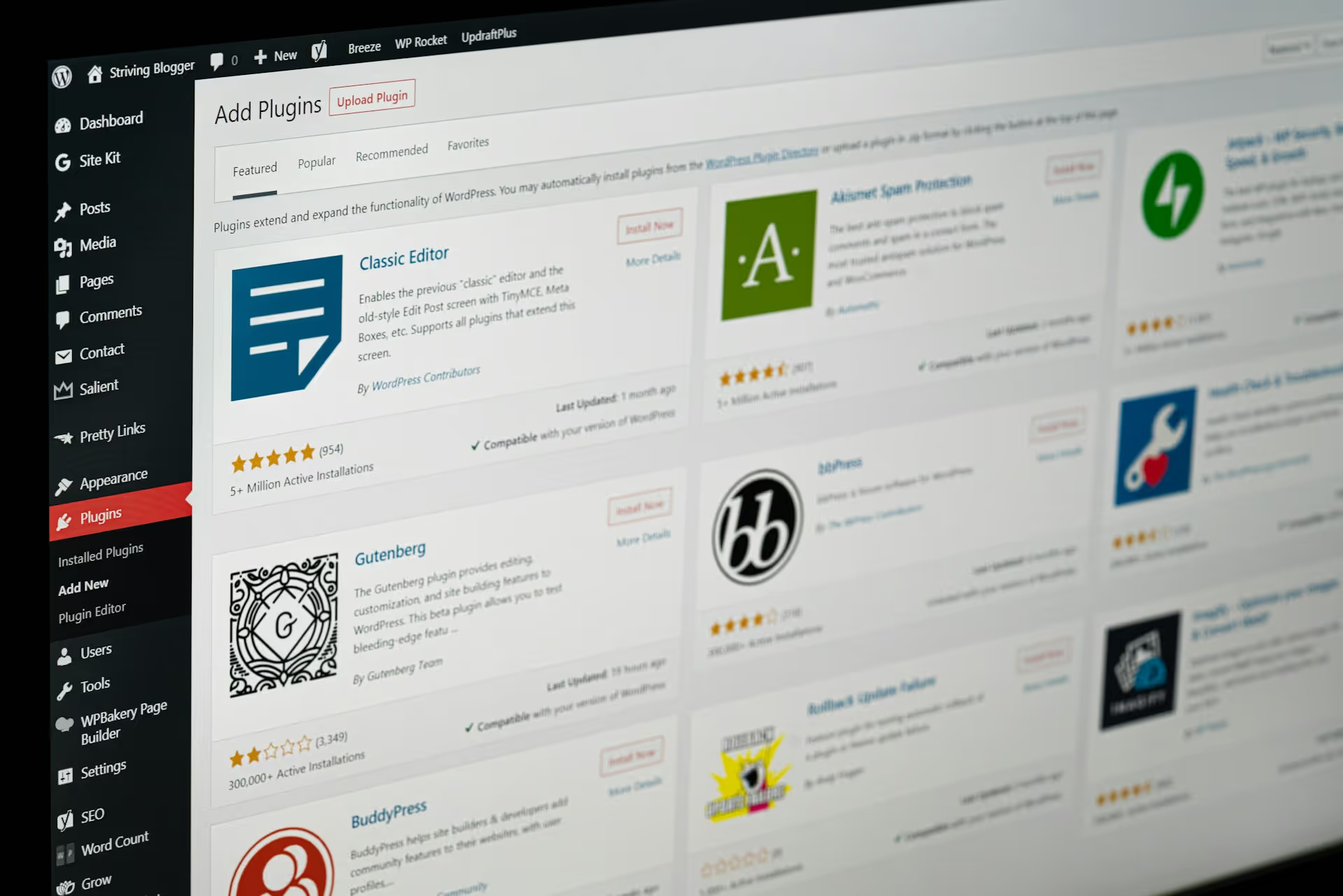
Modern Webflow and WordPress builds, when done right, give you the flexibility to create modular, AI-ready experiences. This is where Brightter focuses heavily on UX and architecture.
A growth-stage company in 2026 cannot afford a rigid site where every page is hardcoded. You need content blocks, dynamic layouts, and data-driven components that AI systems can understand and adapt.
Your experience layer should also support:
Dynamic content based on user intent
Role-based experiences for different audiences
AI-powered search and chat
Smart forms and lead capture
This is what turns your website from a static asset into a conversion engine.
Layer 2: The Data and Knowledge Layer
AI is only as good as the data it can access.
This layer includes:
Your CRM
Your CMS
Your product data
Your support content
Your sales enablement assets
Your analytics
Your internal documentation
In most companies, this information is scattered across tools like HubSpot, Salesforce, Notion, Google Drive, Zendesk, and marketing platforms. AI cannot reason over chaos.
That is why the modern AI stack requires a unified knowledge layer.
At Brightter, we build systems that connect structured data, unstructured documents, and live databases into one searchable, indexable knowledge base. This is where technologies like vector databases, embeddings, and retrieval-augmented generation (RAG) come in.
Instead of training an AI model from scratch, you create a living memory of your business that AI can query in real time.
This is how you get:
Accurate AI answers
Brand-consistent responses
Up-to-date information
Internal and external intelligence
Your website, sales team, and support channels can all draw from the same source of truth.
Layer 3: The AI and Intelligence Layer
This is where models, logic, and reasoning live.
In 2026, most growth-stage companies do not need to build their own large language model. What they need is the right orchestration of models, embeddings, and workflows.
This layer includes:
LLMs such as GPT, Claude, or industry-specific models
Embedding models for semantic search
RAG pipelines that connect models to your data
Prompt systems that enforce brand voice and compliance
Fine-tuned logic for your use cases
This is how you create AI that feels like it belongs to your company.
Your AI should know:
Your products
Your pricing
Your positioning
Your tone
Your customer types
Without this layer, AI becomes generic and risky. With it, AI becomes a competitive advantage.
Layer 4: Search and Discovery
Search is now multi-dimensional.
You must be discoverable on:
Google
Bing
ChatGPT
Perplexity
AI browsers
Voice assistants
Vertical AI tools
This is where Generative Engine Optimization comes in.
GEO goes beyond keywords. It focuses on making your content, data, and authority easy for AI systems to understand, reference, and trust.
At Brightter, we build:
Schema and structured data
Semantic content models
Entity-based SEO
Conversation-optimized pages
Knowledge graph alignment
This ensures that when someone asks an AI engine about solutions in your category, your brand shows up as the authoritative answer.
Layer 5: Automation and Workflow
This is where the AI stack drives real business value.
This layer connects AI to:
Lead routing
Email and CRM
Sales enablement
Customer support
Internal operations
Imagine a system where:
New leads are qualified by AI
Sales receives context-rich insights
Support tickets are triaged automatically
Content updates flow from product changes
Forecasts update in real time
This is what turns AI into leverage.
Layer 6: Analytics and Optimization
AI systems improve through feedback.
This layer measures:
User behavior
Conversion paths
Search performance
AI answer quality
Revenue impact
You need dashboards that show not just traffic, but intent, engagement, and outcomes.
This is how you know what is working and where to invest next.
How Brightter Builds AI Stacks
Brightter does not sell tools. We build systems.
Our AI transformation approach brings together:
UX and design
Web platforms
Data architecture
AI pipelines
SEO and GEO
Automation
Analytics
We design everything to work as one.
For growth-stage companies, this means:
Faster sales cycles
Higher conversion rates
Lower support costs
Better visibility
Smarter decisions
Your website becomes the front end of an intelligent business.
Why This Matters in 2026
In 2026, AI is not a feature. It is the operating system of growth.
Companies that build real AI stacks will:
Be found by AI search
Personalize every interaction
Move faster than competitors
Learn from their data
Scale without breaking
Companies that do not will look outdated, invisible, and inefficient.
Final Thoughts
The AI stack is not about hype. It is about structure.
When your UX, data, AI, search, and automation work together, your business becomes smarter every day.
That is what Brightter builds.
If you are a growth-stage company ready to scale in 2026, your AI stack is your advantage.