.avif)

The Ultimate Guide to Website Design for Austin Businesses That Want to Scale
Key Takeaways
- Austin rewards sites that are both beautiful and functional. Aesthetics or function alone will not compete in this market.
- Start with brand, not layout. Define what your brand stands for first, then let typography, color, and tone express it consistently.
- Build for conversion and clarity. Sharp positioning, strategic user flow, and conversion-centered design turn visitors into customers.
- Bake in SEO and performance from day one. Fast, resilient, mobile-first sites with SEO architecture set up early avoid expensive rework later.
- Plan for scale. A flexible CMS and scalable tech stack let marketing teams move quickly as the business grows.
a. Introduction:
Austin isn’t just the “next Silicon Valley”—it’s a market of its own. A city where creativity, entrepreneurship, and tech innovation collide. With new startups launching every week, established companies rebranding for relevance, and an ever-expanding digital economy, your website has never mattered more.
But here's the catch: most websites are either built for aesthetics or built for function—not both. And neither alone is enough.
Whether you’re a SaaS company targeting enterprise clients, a DTC brand selling handmade goods out of South Congress, or a boutique agency scaling from three people to thirty, your website needs to do more than “exist.” It needs to attract, convert, and adapt in real time. Because in a market this competitive, outdated, templated, or clunky digital experiences don’t just fall short—they repel your ideal customers.
The businesses thriving in Austin today are investing in digital experiences that are:
- Built to scale
- Rooted in brand strategy
- Fueled by SEO
- Designed for humans
- And engineered to convert
This guide isn’t a surface-level walkthrough. It’s a detailed, step-by-step blueprint that pulls from Brightter’s firsthand work with high-growth Austin companies—from tech startups and legal firms to creative studios and wellness brands. We’re sharing what works, what fails, and how to think bigger about the role your website plays in your business’s next chapter.
b. 10 Elements Every High-Performing Austin Website Must Have
1. Brand-First Strategy
Your website is the single most powerful extension of your brand in the digital world. A brand-first strategy means ensuring that every visual and functional element of your site aligns with your company’s personality, values, and positioning. For Austin businesses—whether you're an eco-conscious CPG brand or a disruptive tech startup—your brand must be unmistakable.
A brand-first website doesn’t start with layout; it starts with soul. You must define what your brand means before deciding what it looks like. Typography, color palette, iconography, and tone of voice should all echo your brand’s essence. Consider the difference between a minimalist, modern look for a tech firm in The Domain versus a vibrant, playful aesthetic for an East Austin coffee roaster.
This also includes copywriting—microcopy, CTAs, headlines, and error messages should be written in a way that reflects your brand voice. Even hover states and scroll animations should feel intentional. A consistent brand identity instills trust, encourages engagement, and differentiates you in a saturated market.
2. Clarity in Positioning
Clarity beats cleverness every time. A user landing on your website should know three things within 5–7 seconds: who you are, what you do, and why it matters to them. Most websites fail here because they try to do too much—or say too little.
Austin’s market is fast-paced. Your customers are making decisions quickly, often between multiple tabs. That’s why your homepage needs to feature a clear headline, a subheading that articulates your value proposition, and a CTA that encourages action.
This clarity should continue throughout the site. Service pages should explain offerings with precision, not jargon. About pages should show your team’s credibility and personality. FAQs should answer real questions, not generic filler. Clarity also extends to visual hierarchy—make sure the most important information is impossible to miss.
When we design websites at Brightter, we start every project with a messaging framework that ensures your positioning is communicated consistently across every section of the site.
3. Fast, Resilient Performance
Performance isn’t optional—it’s foundational. If your website doesn’t load within 2–3 seconds, you’re already losing potential leads. Google has made page speed a ranking factor, and more importantly, users now equate speed with credibility.
For scaling Austin businesses, performance optimization is about more than installing a caching plugin. It means:
- Minifying CSS, JavaScript, and HTML
- Compressing images and serving them in next-gen formats like WebP
- Lazy loading non-critical elements
- Using efficient CDNs with server locations optimized for Austin and surrounding regions
Beyond speed, resilience matters. Your site should handle traffic spikes without crashing, especially during product launches or press events. If you’re an e-commerce brand featured in Austin Monthly or a startup post-Y Combinator Demo Day, traffic can surge overnight.
Brightter ensures all of our sites pass Core Web Vitals and use performance monitoring tools like Lighthouse and GTmetrix to ensure long-term reliability.
4. Mobile-First Experience
In Austin, where tech-savvy professionals, students, and creatives are constantly on the move, a mobile-first design approach isn’t just smart—it’s essential. With more than 60% of web traffic coming from mobile devices, your website should be built with the mobile experience at the center of its design strategy.
Mobile-first doesn’t mean “mobile-friendly.” It means designing your entire experience with mobile use cases as the baseline. That includes thumb-friendly navigation, large and tappable CTA buttons, vertical scrolling UX, and content that reads effortlessly on smaller screens. Your mobile site must load quickly, feel intuitive, and make every interaction seamless—from browsing to booking.
Austin users, especially those exploring events, products, or services while commuting or attending meetups and conferences, expect sites to perform flawlessly on the go. Menus should collapse cleanly, product carousels should swipe effortlessly, and forms should autofill without friction.
Brightter ensures mobile-first designs through device testing across multiple screen sizes, performance profiling for 4G and 5G environments, and custom animations that enhance mobile engagement without compromising speed.
5. Strategic User Flow and Navigation
A website’s architecture should be intuitive, not overwhelming. Strategic user flow starts with understanding why people visit your site in the first place—and then structuring their journey around that intent. Whether it’s a potential client looking for pricing, a media outlet searching for your press kit, or a partner scanning your leadership page, your navigation should deliver them to the right place in two clicks or less.
Navigation should mirror your sales funnel. Key pages should be prioritized and linked throughout the site—not just in the menu. Internal linking should serve SEO goals and keep users engaged, moving them logically from one point to the next. Clear breadcrumb trails, sticky nav bars, and smart footer design all contribute to keeping visitors oriented.
In our Austin-based projects, Brightter often builds out interactive journey mapping in the early planning phase. This lets us validate paths based on user personas and buying stages. That way, every click is purposeful—and leads to conversion.
6. Conversion-Centered Design
Conversion-centered design is more than bold buttons and popups—it’s a methodology rooted in behavioral psychology, funnel alignment, and clarity. Every page of your website should be reverse-engineered from the outcome you want: whether that’s a lead form submission, a demo booking, a purchase, or even an email sign-up.
Start by defining a clear primary CTA for each page. Then, support that CTA with a logical hierarchy of content, visual cues (like arrows, icons, or contrast shifts), and social proof. Your homepage should guide users to high-converting subpages; your landing pages should reduce friction and objection; your footer should reinforce action for those who scroll to the bottom.
In Austin, users are bombarded by ads and branded content—so clarity and brevity are competitive advantages. Reduce cognitive load with smart use of whitespace, microcopy that sets expectations (“Takes 2 minutes”), and non-intrusive lead capture like scroll-based popups or embedded forms.
Brightter integrates heatmaps and session recordings pre- and post-launch to identify conversion blockers. Our philosophy: don’t guess—optimize with data.
7. SEO Architecture from Day One
Most businesses treat SEO as an afterthought. We believe it should be part of your site’s foundation. A well-structured SEO architecture isn’t just about keywords—it’s about designing a content and navigation system that makes sense to both users and search engines.
For Austin brands, local intent matters. From geo-targeted service pages (“Branding Agency in South Austin”) to optimized Google Business integration, we ensure your site is optimized for discovery and relevance.
Our process includes:
- Comprehensive keyword research around local and industry-specific terms
- URL structures that mirror your information hierarchy
- H1–H6 tags that reflect content priorities
- Schema markup for reviews, FAQs, events, and products
- Optimized media assets with alt tags and descriptive filenames
And we don’t stop at launch. Brightter continues optimizing technical SEO (sitemaps, crawl budgets, canonical tags) as your content library grows.
8. CMS Flexibility for Marketing Teams
If your marketing team has to Slack the dev team every time they want to update a headline, you’ve got a bottleneck. A powerful CMS (Content Management System) puts content creation and updates in the hands of marketers—without sacrificing design integrity.
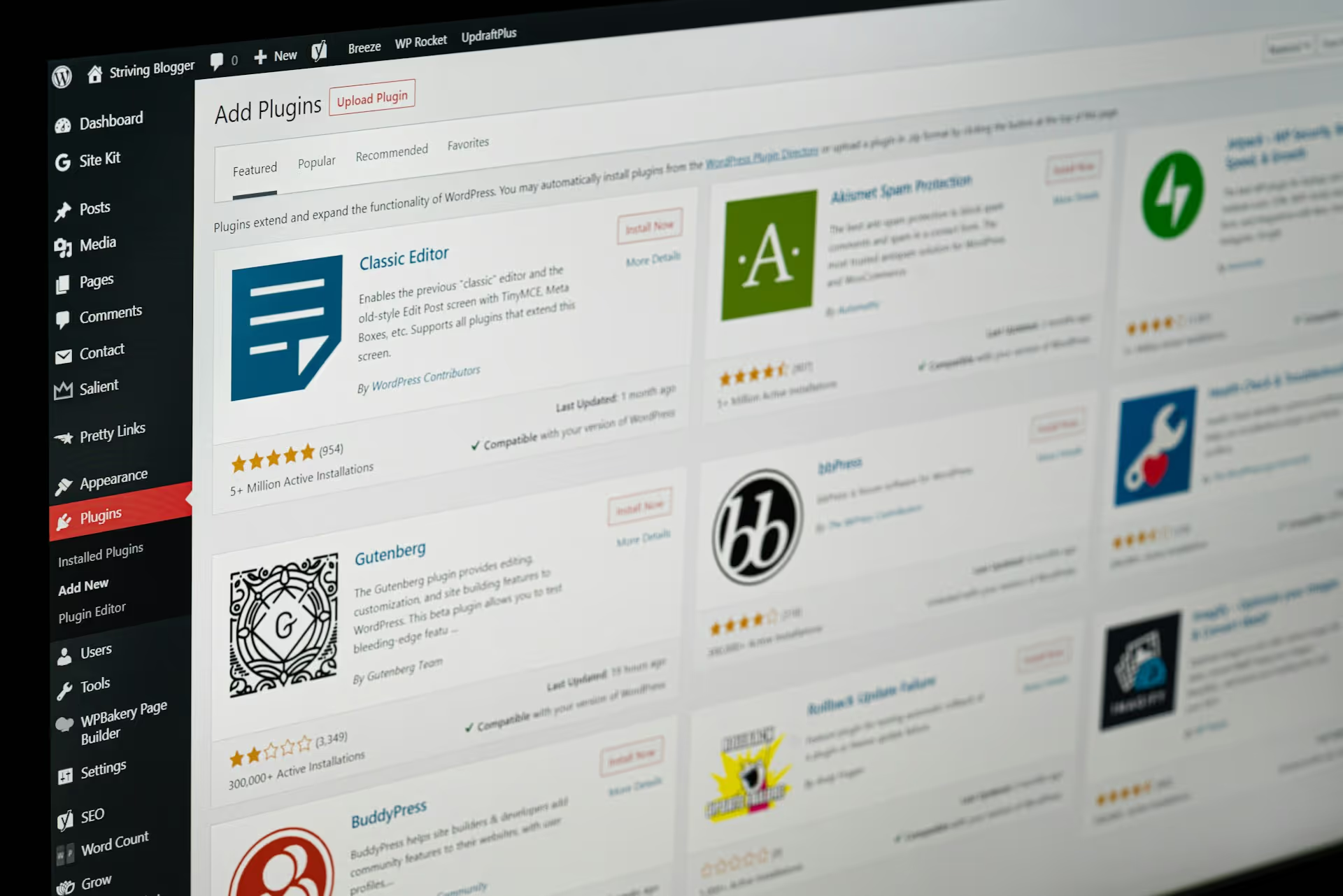
We build modular CMS frameworks using tools like Webflow CMS, WordPress (with Advanced Custom Fields), or even headless setups integrated with platforms like Contentful or Sanity.
This flexibility allows you to:
- Launch new landing pages in hours—not weeks
- A/B test hero sections or CTAs directly in the CMS
- Manage team bios, case studies, blogs, and press content with ease
In fast-growing Austin companies, agility is key. Brightter empowers your non-technical team to publish, iterate, and grow—without losing brand cohesion.
9. Scalable Tech Stack
As your business scales, so must your website. If your stack can’t handle a surge in traffic, support new features, or integrate with your CRM, you’ll outgrow your site before you outgrow your market.
We choose platforms based on business model, internal team skill sets, and long-term growth goals. For example:
- Webflow for startups and creative teams who prioritize speed and design
- WordPress for publishing-heavy or SEO-driven organizations
- Headless CMS + Jamstack for enterprise-level speed, security, and control
We also future-proof with API-ready integrations, scalable e-commerce backends (Shopify or Snipcart), and performance-first hosting solutions.
The right stack lets you add features—like gated content, referral programs, or multilingual support—without starting from scratch.
10. Post-Launch Optimization Plan
Launching your site is just the beginning. Without continuous improvement, even the best websites lose relevance. A post-launch strategy ensures your digital presence adapts as user behavior, business goals, and technology evolve.
Brightter sets up every client with a roadmap that includes:
- Conversion tracking setup with GA4, Hotjar, and Looker Studio dashboards
- Monthly site health checks (broken links, speed audits, accessibility scans)
- CRO experiments using A/B tools like Google Optimize or VWO
- SEO performance reviews tied to content refresh calendars
More importantly, we align these with your business KPIs. Whether you’re targeting qualified leads in the Austin tech scene or selling artisan goods nationwide, your website should evolve as your business does.
c. Conclusion: Your Website Is Your Growth Engine
Austin isn’t just another market—it’s a proving ground for ambitious brands. In a city that blends tech, creativity, and culture, your website has to be more than functional—it has to be unforgettable. It should convert, communicate, and adapt as fast as you do.
From brand storytelling and SEO to performance engineering and content management, every aspect of your site should be intentional and aligned with your business goals. You’re not just building a website—you’re building a digital platform that fuels growth, earns trust, and attracts the kind of clients, customers, or partners that move your business forward.
If your current site feels outdated, clunky, hard to update, or misaligned with your brand’s evolution—this isn’t just a design issue. It’s a growth problem. And it’s solvable.
d. Ready to Build Austin’s Next Great Website?
At Brightter, we partner with Austin brands that don’t just want a better website—they want a smarter one. One that scales. One that sells. One that works.
Whether you need to modernize an existing platform or build something extraordinary from scratch, we’re here to make your next move the right one.
Schedule your free strategy call today and let’s turn your site into your most powerful asset.