.avif)

What AI Enablement Actually Costs an SMB in Year One
Key Takeaways
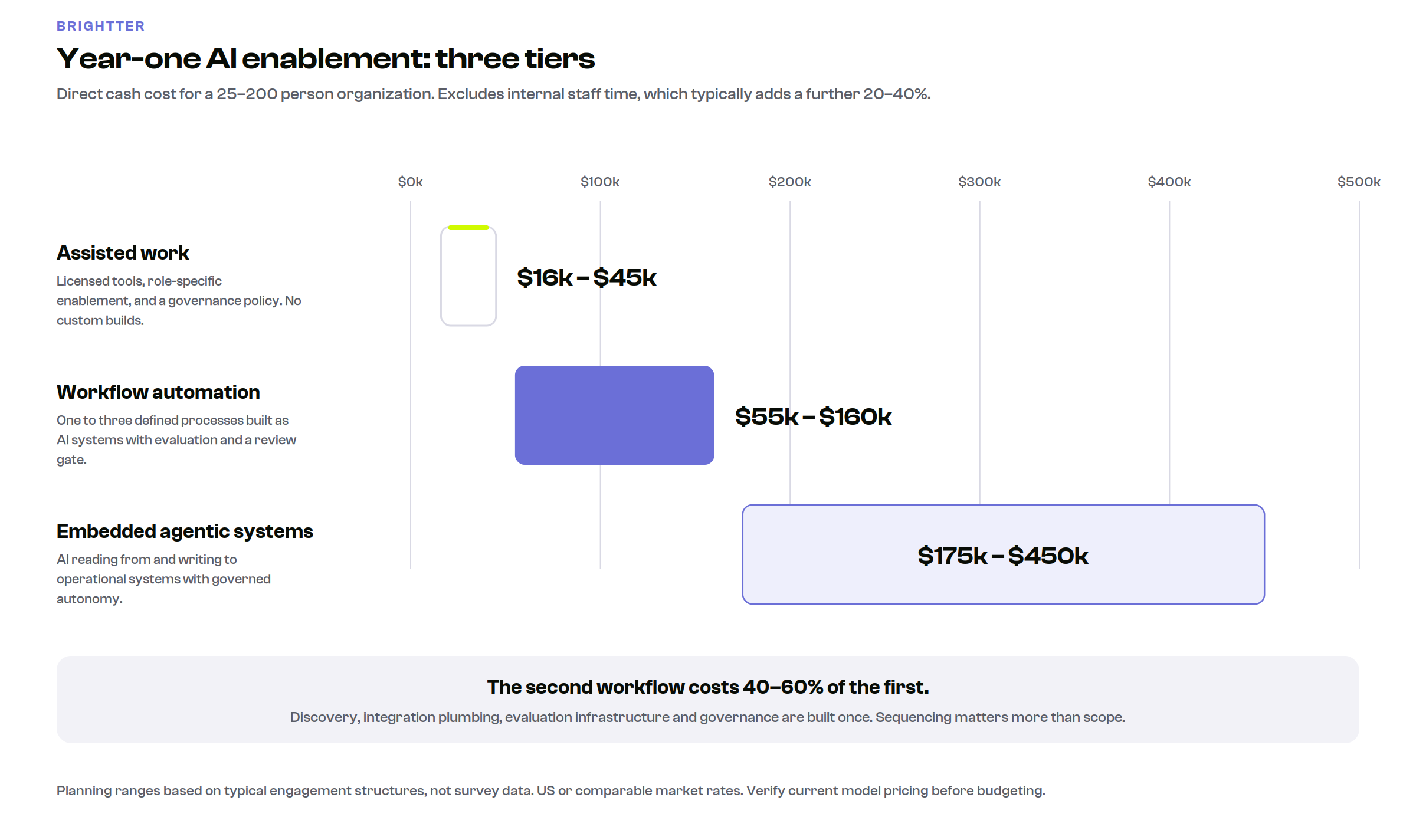
- Year-one AI enablement for a small or mid-sized business falls into three distinct tiers: assisted work ($15,000 to $45,000), workflow automation ($55,000 to $160,000), and embedded agentic systems ($175,000 to $450,000) in direct cash cost
- Inference is almost never the expensive part. For a typical SMB, token spend represents roughly 1% to 5% of year-one cost. A support triage workflow processing 3,000 tickets a month runs on the order of $110 a year in tokens
- The largest cost line is nearly always implementation and integration labor, followed by internal time, which almost no one budgets and which frequently exceeds the software spend
- Five costs are routinely omitted from budgets: data cleanup, evaluation maintenance, change management, security review, and model migration. Together they typically add 20% to 35% to a naive estimate
- The second workflow costs 40% to 60% of the first. Discovery, integration plumbing, evaluation infrastructure, and governance are largely reusable, which is why sequencing matters more than scope
- Data readiness is the single largest variance driver. The same workflow can differ by a factor of three depending on whether the underlying data is clean, accessible, and documented
- Expect payback in 6 to 14 months for well-scoped automation, and treat anything promising sub-90-day payback with suspicion
- Budget 20% to 30% of build cost annually for ongoing operation. AI systems are not fire-and-forget; models change, data drifts, and evaluation sets need maintenance
Introduction: The Answer, Up Front
A small or mid-sized business — call it 25 to 200 employees — should plan on one of three year-one budgets depending on how far it intends to go.
If the goal is assisted work — giving your team good AI tools, training them properly, and setting sensible policy — plan on $15,000 to $45,000 in direct cost. This is mostly licensing plus a modest enablement engagement.
If the goal is workflow automation — taking one to three repeatable processes and building AI systems that do them — plan on $55,000 to $160,000. This is mostly implementation labor.
If the goal is embedded agentic systems — AI that reads from and writes to your operational systems with governed autonomy — plan on $175,000 to $450,000. This is architecture, integration, evaluation infrastructure, and security work.
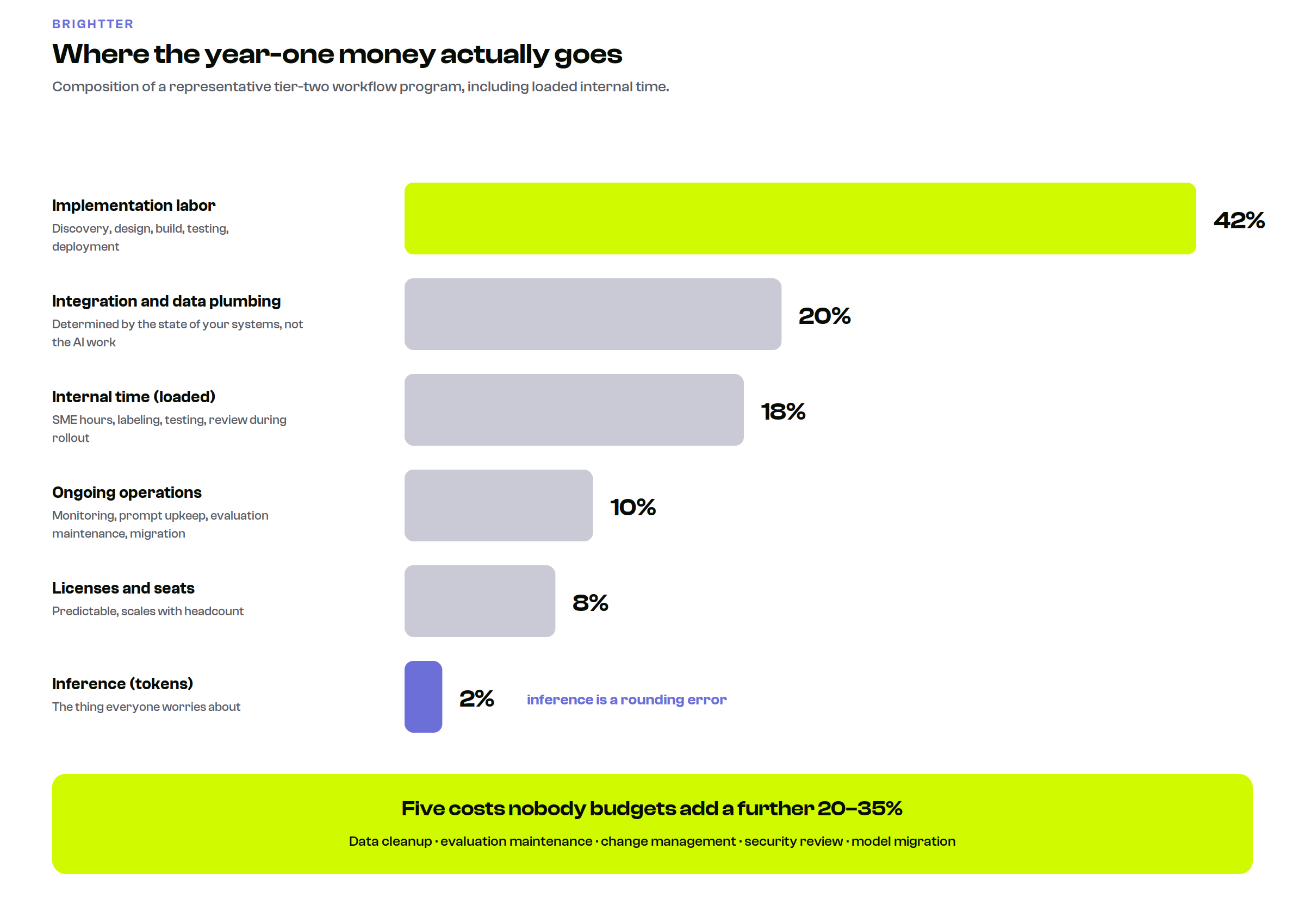
Those ranges are wide because the variance is real, and the rest of this article is about what moves you within them. But the headline that surprises most people is this: in every tier, the cost of the AI itself — the tokens, the model calls, the thing everyone worries about — is a rounding error. The money goes into labor, data, and change.
A note on methodology. These are planning ranges derived from how AI enablement engagements are typically structured and priced, not results from a survey. They assume US or comparable market rates, an organization without an existing internal AI platform team, and commercially available frontier models rather than self-hosted infrastructure. Model pricing referenced below was verified in August 2026 and changes regularly; verify current rates before finalizing a budget. Use these as a starting frame to interrogate a quote, not as a substitute for one.
The Six Cost Categories
Every AI budget decomposes into the same six categories. Most published estimates only count the first two, which is why they are wrong by a factor of two or three.
- 1. Licenses and seats. Per-user subscriptions for assistant tools. Scales with headcount, predictable, easy to budget. Typically the smallest meaningful line for anything beyond tier one.
- 2. Inference and API usage. Token costs for automated workloads. Scales with volume, highly variable by workload shape, and usually far smaller than expected.
- 3. Implementation labor. Discovery, design, build, testing, deployment. Whether internal or external, this is nearly always the largest line item in tiers two and three.
- 4. Integration and data plumbing. Connecting to your systems, normalizing inputs, handling authentication and permissions. Frequently underestimated by the widest margin of any category, because its cost is determined by the state of your systems rather than by the AI work.
- 5. Internal time. Your team's hours: scoping, providing subject matter expertise, labeling evaluation examples, testing, reviewing outputs during rollout, and the ongoing review gate. Real money, rarely on a budget line, and often 20% to 40% of the total when loaded honestly.
- 6. Ongoing operations. Monitoring, prompt maintenance, evaluation set upkeep, model version migration, cost review, and support. Budget 20% to 30% of build cost annually.
Tier One: Assisted Work
What you get: Your team has capable AI assistants, knows how to use them for their actual jobs, and operates under a policy that legal and security have signed off on. No custom systems, no integrations.
Who this is right for: Organizations that have not yet established which workflows are worth automating. This tier is also the cheapest way to find out, because the workflows people automate informally with a chat tool are a remarkably reliable signal of where the real leverage is.
- Assistant seats: $9,000 to $22,000. Roughly 30 licensed users; per-seat rates vary meaningfully by tier and vendor.
- Enablement and training: $5,000 to $15,000. Role-specific workshops beat generic training by a wide margin.
- Policy and governance setup: $2,000 to $8,000. Acceptable use, data handling, approved tools, review requirements.
- Direct cash total: $16,000 to $45,000.
- Internal time, loaded: $10,000 to $25,000. Champion time, training attendance, policy review.
Where this goes wrong: buying seats and calling it a program. Licenses without role-specific enablement produce a predictable pattern — enthusiastic first month, 20% sustained usage, and a renewal conversation nobody can justify. The training line is not optional; it is what converts the license spend into anything.
The efficient version: license a subset rather than everyone, run genuinely role-specific sessions (what a controller does with AI is nothing like what a sales rep does), and instrument adoption from day one so the renewal decision has evidence behind it.
Tier Two: Workflow Automation
What you get: One to three defined processes running as AI systems, with defined inputs and outputs, evaluation, monitoring, and a human review gate. Real, measurable operational change.
Typical candidates: inbound request triage and routing, document data extraction, first-draft generation with human approval, structured summarization of recurring inputs, quality checking against a rulebook.
- Discovery and scoping: $8,000 to $20,000. Process mapping, baseline measurement, evaluation design.
- Build, per workflow: $15,000 to $45,000. Input handling, prompts, output contracts, validation, review gate.
- Integration: $5,000 to $25,000. Highly dependent on the state of your systems.
- Inference, annual: $600 to $6,000. See the worked math below.
- Deployment and rollout support: $5,000 to $15,000. Shadow mode, staged rollout, override review.
- Ongoing operations, annual: $8,000 to $25,000. Roughly 20% to 30% of build.
- Continued seats: $9,000 to $22,000. Tier one costs generally continue.
- Direct cash total, one workflow: $55,000 to $110,000.
- Direct cash total, three workflows: $95,000 to $160,000. Not three times one — see below.
- Internal time, loaded: $20,000 to $50,000. SME time, labeling, testing, review during rollout.
Why three workflows do not cost three times one. Discovery methodology, integration plumbing, evaluation infrastructure, logging, cost controls, and governance are largely built once. The second and third workflows typically run 40% to 60% of the first. This is the most important sequencing insight in the entire budget: the marginal cost curve bends sharply downward, which means the decision that matters is which workflow goes first, not how many you eventually do.
Choose the first workflow on four criteria: it is high-frequency (so improvement compounds), the current cost is measurable (so ROI is provable), errors are recoverable (so you can tolerate a learning period), and one person genuinely wants it (so someone will use it).
Tier Three: Embedded Agentic Systems
What you get: AI that operates inside your systems with governed autonomy — reading records, taking actions, orchestrating multi-step work across tools, with identity, permissions, and audit built in.
Who this is right for: organizations where the workflow value is high enough to justify the governance overhead, and where a security failure would be materially costly. Most SMBs should reach tier three after tier two, not instead of it.
- Architecture and security design: $25,000 to $60,000. Identity, least-privilege access, audit design.
- Core build: $80,000 to $200,000. Agent logic, orchestration, tool definitions, failure handling.
- Integration layer: $30,000 to $80,000. Connectors, authentication, permission propagation.
- Evaluation infrastructure: $15,000 to $40,000. Golden sets, regression harness, drift monitoring.
- Security review and compliance: $10,000 to $40,000. Higher in regulated industries.
- Inference, annual: $3,000 to $40,000. Agentic workloads consume far more tokens per task.
- Ongoing operations, annual: $25,000 to $70,000.
- Direct cash total: $175,000 to $450,000.
- Internal time, loaded: $50,000 to $120,000.
The defining cost driver here is not capability but permission. A system that reads is meaningfully cheaper than a system that writes, and a system that writes to one system is meaningfully cheaper than one that writes to five. The security and governance work scales with the blast radius of what the agent can do, and that work is not optional — an agent with broad write access and no audit trail is a liability that will eventually be discovered by someone other than you.
The Inference Math, Worked
The single most common budgeting error is dramatically overestimating token cost. Here is the actual arithmetic on three representative workloads, using published rates as of August 2026: Haiku 4.5 at $1 input and $5 output per million tokens, and Sonnet-tier at $3 and $15 (standard rate; an introductory $2 and $10 applies through the end of August 2026).
Support ticket triage — 3,000 tickets a month. Classification and routing at roughly 1,500 input and 300 output tokens per ticket on the Haiku tier. Input works out to $4.50 a month and output to $4.50 a month, for roughly $110 a year.
Document analysis — 500 documents a month. Roughly 40,000 input and 2,000 output tokens per document on the Sonnet tier. Input is $60 a month and output $15 a month, for roughly $900 a year.
Internal knowledge assistant — 50 users, 20 queries a day, 250 working days. That is 250,000 queries a year at roughly 6,000 input tokens (4,000 of them a cached prefix) and 500 output. Cached input costs about $300 a year, fresh input about $1,500, and output about $1,875, for roughly $3,700 a year.
Every one of these can be reduced substantially further: prompt caching already reflected above cuts cached input to roughly a tenth of base rate, batch processing halves both directions for asynchronous work, and routing simple tasks to a cheaper tier produces the largest saving of all.
The conclusion is unambiguous. For an SMB, inference typically lands between 1% and 5% of year-one cost. Teams that spend three weeks optimizing token spend while running an unevaluated system have optimized a line item two orders of magnitude smaller than the one that matters. Rates change frequently; verify current pricing before budgeting.
The Five Costs Nobody Budgets
These are the line items that turn a $70,000 estimate into a $95,000 actual.
1. Data cleanup — $5,000 to $50,000. Almost every project discovers that the data is worse than believed. Inconsistent formats, missing fields, duplicate records, undocumented conventions, three systems disagreeing about the same customer. This work would have needed doing eventually; AI just forces the reckoning early. It is also the single largest source of budget variance.
2. Evaluation maintenance — $5,000 to $15,000 a year. Golden sets go stale. New edge cases surface. Model versions change and require regression runs. A system without evaluation maintenance degrades invisibly, which is the worst way for it to degrade.
3. Change management — $10,000 to $30,000. Communication, training, handling resistance, redesigning the surrounding process. The process almost always needs redesign, because automating a step inside a badly designed process just produces a faster bad process.
4. Security and compliance review — $5,000 to $40,000. Vendor assessment, data flow documentation, permission model review, penetration testing for anything customer-facing. Substantially higher in healthcare, financial services, and regulated sectors — and if you are in one, get this reviewed at design time rather than at launch, when a finding is ten times more expensive to remediate.
5. Model migration — $5,000 to $20,000 per major change. Underlying models are updated and deprecated on the vendor's schedule, not yours. Each meaningful change requires re-running your evaluation set and sometimes adjusting prompts. Assume at least one per year.
Combined, these typically add 20% to 35% to a naive estimate. A budget without a contingency line for them is not a budget.
What Drives the Variance
Four factors explain most of the spread within each tier.
- Data readiness — up to a 3x swing. Clean, accessible, documented data versus scattered across systems with undocumented conventions. This is the biggest single lever and it is mostly determined before the project starts.
- Integration surface — up to a 2.5x swing. Modern systems with good APIs and available connectors versus legacy systems, on-premise databases, or anything requiring screen scraping.
- Process documentation — up to a 2x swing. A workflow with written rules can be specified in days. A workflow that lives in one experienced person's head requires extracting it first, which is genuinely difficult work and often reveals that different people do it differently.
- Regulatory environment — up to a 2x swing. Healthcare, financial services, and legal carry review requirements, audit obligations, and data handling constraints that add real cost.
Measuring ROI Without Fooling Yourself
Establish the baseline before you build. How long does the task take today, how often is it wrong, what does that cost? Without a pre-measurement, any post-measurement is an argument rather than evidence. This step takes a week and is skipped constantly.
Count only recoverable time. Two hours saved across twenty people is worth very little unless something concrete now fills those hours. Time savings become financial returns when they convert into avoided hiring, increased throughput on a capacity-constrained function, or faster cycle times on revenue-generating work. Be honest about which of those applies, and be honest when the answer is none of them.
Count error reduction, which is frequently the larger benefit. Fewer misrouted requests, fewer data entry mistakes, fewer missed deadlines. Often easier to quantify than time savings and harder to argue with.
Expect payback in 6 to 14 months for a well-scoped tier-two workflow. Faster than that usually means the baseline was overstated. Slower usually means the workflow was too low-frequency to justify automation, which is a scoping error rather than a technology failure.
Track the second-order benefit. The organization that completes one workflow properly has built the evaluation infrastructure, integration plumbing, and internal capability that makes the next three cheaper. That compounding is real and belongs in the business case, even though it is harder to put a number on.
Where the Money Gets Wasted
Five patterns account for most wasted AI budget.
- Buying a platform before defining a workflow. Platform subscriptions bought in advance of a specific use case get used for nothing in particular. Define the workflow, then choose the tooling.
- Automating a low-frequency process. Something done twice a month does not justify a build. Frequency is the numerator of every AI business case.
- Skipping evaluation. Systems without evaluation cannot be improved, only argued about. This is the cheapest step to skip and the most expensive one to have skipped.
- Building custom where a product exists. If a mature vendor solves your problem at a tenth the cost, buy it. Build where your process is genuinely differentiated, which is less often than teams assume.
- Solving for the impressive rather than the frequent. The most technically interesting problem in the organization is rarely the most valuable one. The boring, high-volume, well-defined process is where the return lives.
Build, Buy, or Partner
Buy when a mature product covers your workflow. Fastest, cheapest, lowest risk. The constraint is fit — you adapt to the product's assumptions.
Build internally when the workflow is core to your differentiation, you have engineering capacity to spare, and you can commit to ongoing maintenance. The failure mode is the departure of the one person who understood it.
Partner when you need production-grade work faster than you can hire for it, or when you want internal capability built alongside the system rather than delivered as a black box. The failure mode is a dependency you cannot maintain, so make knowledge transfer and documentation explicit deliverables rather than assumed courtesies.
Most SMBs land on a mix: buy the assistant layer, partner for the first one or two workflows and the evaluation infrastructure, and build internally once the pattern is established and the team has learned the discipline.
The Brightter Perspective
Cost opacity is the main reason AI projects get approved badly or not at all. Vendors quote implementation and omit ongoing operations. Estimates count licenses and ignore internal time. Nobody prices data cleanup until it is discovered mid-project. The result is either sticker shock at month eight or a program that dies quietly because nobody could justify the next phase.
The honest version is less dramatic than either the hype or the backlash suggests. AI enablement for an SMB is a normal capital allocation decision with a comprehensible cost structure, a measurable return, and a real risk of waste if it is scoped badly. The costs are knowable in advance. The returns are provable if you measure the baseline first. And the most expensive mistakes are almost always scoping mistakes made before anything was built.
At Brightter, we help small and mid-sized organizations size this realistically: identifying which workflow actually justifies automation, building the evaluation that proves whether it worked, and structuring the engagement so the second and third workflows cost meaningfully less than the first.
Conclusion
Year one costs $15,000 to $45,000 for assisted work, $55,000 to $160,000 for workflow automation, and $175,000 to $450,000 for embedded agentic systems, plus internal time that most budgets never account for and a 20% to 35% allowance for the costs that surface mid-project.
The tokens are close to free. The labor is not. The internal time is real. The data cleanup is unavoidable and should be budgeted rather than discovered. And the compounding is genuine — the organization that gets one workflow right has built most of what the next three need.
Scope narrowly, measure the baseline before you build, budget for operations rather than just construction, and write down what failure would look like before you start.
If your organization is trying to size an AI investment honestly and pick the workflow most likely to justify it, that assessment is the highest-return week you will spend. Start a project at brightter.com/start-a-project.