.avif)

What AI-Ready Actually Means for a 50-Person Company
Key Takeaways
- AI-ready is not a technology state. It is a five-layer stack — data, process, governance, skills, ownership — and every layer is load-bearing for the ones above it
- The 25-to-200 person band is structurally the hardest place to adopt AI, and not for the reason people assume. It is not budget. It is that you are large enough to have real process and small enough that none of it is written down
- Most organizations build the stack top-down and it fails predictably. Buying tools before the data and process layers exist produces activity without capability, which is the single most expensive pattern in the category
- Readiness requires no new headcount. It requires four existing people to each accept one added responsibility — sponsor, process owner, technical operator, and a security or finance sign-off
- The most damaging structural error is merging the sponsor and the process owner. One person then holds authority without domain detail, and the project quietly optimizes for what that person can personally verify
- Readiness is per-workflow, not per-company. The correct question is never “are we AI-ready” but “are we ready for this specific workflow,” and the answer differs across workflows in the same building
- Four things that are not readiness: a data lake, an AI strategy document, a platform subscription, and a newly hired head of AI. All four are frequently mistaken for it
- For a single well-chosen workflow, ninety days is a realistic path from nothing to ready, and roughly eighty percent of that work is organizational rather than technical
Introduction: A Term With No Definition
“AI-ready” appears in vendor decks, board updates, and the anxious internal memo that follows a competitor's announcement. It is almost never defined, which makes it useless as a target and unfalsifiable as a claim. You cannot tell whether you are ready, whether you are getting closer, or what would have to change.
The vacuum gets filled by proxies, and the proxies are consistently wrong. A company decides it is AI-ready because it purchased licenses. Another decides it is not, because its data “is a mess” — a conclusion nobody has measured. A third hires a head of AI and treats the requisition as the milestone.
None of those is readiness. Readiness is a structural property, and it is observable. This article gives it a definition specific enough to test against: five layers, each with a concrete pass criterion, plus the ownership map that makes the whole thing operable without hiring anyone.
The focus is deliberately the 25-to-200 person organization, because that band has a distinct and under-discussed problem, and most published guidance is written either for individuals or for enterprises with platform teams.
Why Fifty People Is Structurally the Hardest Size
The common explanation for why mid-sized companies struggle with AI is budget. That explanation is mostly wrong, and it obscures the real constraint.
Consider the three regimes.
Below roughly 25 people, there is essentially no process to automate. Work is done by whoever is available, differently each time, and the founders hold the entire operating model in their heads. This sounds like a disadvantage and is partly an advantage: AI assistance helps individuals immediately, and nobody expects systematic workflows. There is nothing to document because there is no repeated process to document.
Above roughly 200 people, formalization has already happened for unrelated reasons. Compliance obligations, audit requirements, and the impossibility of coordinating verbally have forced process documentation, access control, and systems of record into existence. When an AI initiative starts, most of the readiness stack is incidentally already built.
Between 25 and 200 is the awkward middle, and the awkwardness is specific: the organization is large enough to have real, repeated, valuable processes and small enough that none of them are written down. The process exists — it happens forty times a week — but it exists as accumulated judgment in three or four experienced people. It has never needed to be externalized because those people have always been reachable.
This is exactly the condition under which AI adoption is hardest, because an AI workflow requires the process in a form a person cannot supply on demand. The knowledge is present and inaccessible at the same time. And critically, this constraint is invisible from inside — nobody experiences the absence of documentation as a gap when every question gets answered promptly.
The practical consequence: at this size, the binding constraint is almost never technology or budget. It is externalization. Which is good news, because externalization is weeks of work rather than a capital program.
The Five-Layer Readiness Stack
Readiness has a structure, and the structure has a direction. Each layer depends on the ones beneath it.
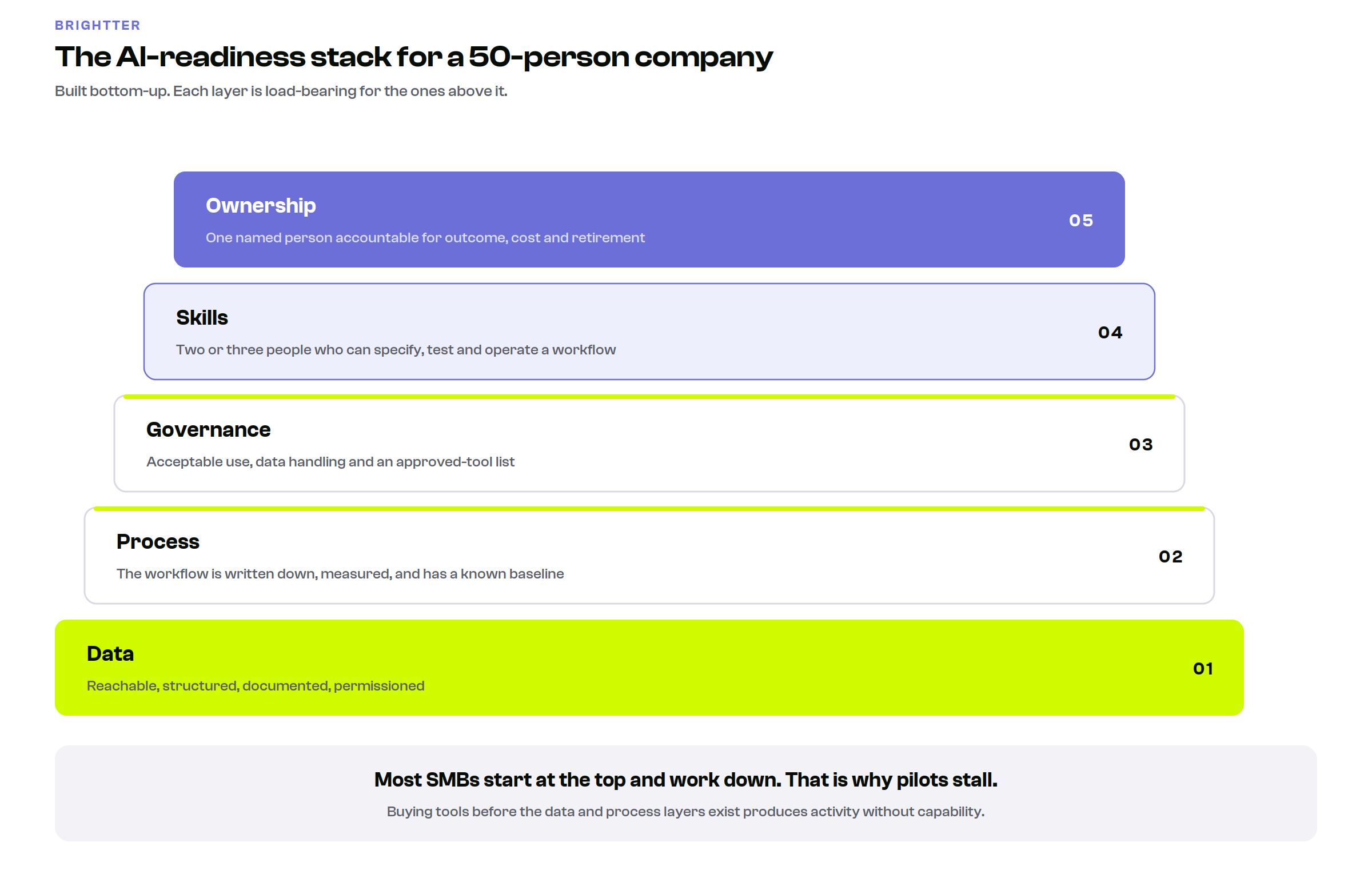
Layer 1 — Data
Ready means: the data a candidate workflow needs is reachable by a program without a human step, structured enough to be predictable, documented enough that its fields have written definitions, and permissioned in a way a system can respect.
The test: can someone write a script today that pulls the last hundred records this workflow would touch, without asking a colleague to export anything? If no, this layer is not ready, and nothing above it can be.
What people get wrong: assuming this means all their data. It means the two or three sources one workflow touches. Scoping this narrowly is what converts an eighteen-month program into a three-week task.
Layer 2 — Process
Ready means: the workflow is written down in enough detail that a competent new hire could execute it from the document, including the exceptions. It has a measured baseline — how long it takes today and how often it is wrong today.
The test: hand the document to someone who has never done the task and watch them attempt it. Every question they ask is a gap in the specification, and every gap would have become a defect in the automated version.
What people get wrong: believing the process is documented because a flowchart exists. Flowcharts capture the happy path. The value is in the exception catalog, which is where automation actually fails.
This layer is where most 50-person organizations discover their real project. The work of writing down a process that has lived in someone's judgment for six years is genuinely difficult, cannot be delegated to a junior person, and routinely surfaces that two departments have been doing it differently. It is also, done properly, valuable independent of any AI initiative.
Layer 3 — Governance
Ready means: there is a written acceptable-use position, a defined stance on what data may leave your environment, an approved-tool list, and a review requirement for AI-generated output in customer-facing or regulated contexts.
The test: if an employee pasted a customer contract into a consumer chatbot this afternoon, is there a policy that addresses it, and does anyone know the policy exists?
What people get wrong: treating governance as a late-stage compliance chore. At this size it takes days, not months, and doing it early removes the most common cause of late-stage project death — a legal question raised for the first time in the approval meeting, when the answer is expensive and the momentum is spent.
Worth noting plainly: your employees are already using AI tools. Governance is not a decision about whether to allow it. It is a decision about whether the use is visible.
Layer 4 — Skills
Ready means: two or three people can specify a workflow precisely, evaluate whether output is correct, and operate a running system — watching cost, error rate, and override frequency.
The test: can someone in your organization look at fifty AI outputs and tell you what percentage are acceptable, using a written standard rather than a general impression?
What people get wrong: assuming this means engineers. It does not. The scarcest and most valuable skill here is evaluation — the ability to define correct precisely enough to measure it — and that is a domain skill, not a technical one. Your best operations person is a better candidate than a developer with no domain context.
Layer 5 — Ownership
Ready means: one named person is accountable for the outcome, the cost, and the decision to retire the system. Not a committee. Not a team. A person, in writing.
The test: if the workflow produced a wrong answer that reached a customer at 4pm on a Friday, who is called?
What people get wrong: believing ownership is implied by seniority. It has to be explicit and bounded — including a stated spend authority — or every decision escalates and the system drifts. Unowned AI systems degrade silently, because the data changes, the model version changes, and quality erodes for weeks before anyone's job description makes them responsible for noticing.
Why Building Top-Down Fails
Almost every organization builds this stack in the wrong order, and the reason is entirely rational.
The top layers are legible. Hiring someone, buying a platform, announcing an initiative — these are visible, they are announceable, and they feel like progress within a week. The bottom layers are illegible: documenting a process produces a document nobody outside the team will read, and fixing data access produces nothing anyone can see.
So organizations buy tools, appoint a lead, and announce a program. Then the program encounters the data layer, discovers the process was never written down, and stalls — usually four to six months in, with the budget partly consumed and the political capital largely spent.
The diagnostic that identifies this early: if your AI initiative currently consists of tools purchased and a person appointed, but nobody can name the specific workflow or produce its written specification, you are building top-down. The correction is inexpensive if made in month two and very expensive if made in month eight.
The inversion also explains a pattern that otherwise looks like bad luck: companies with similar budgets and similar tools getting wildly different outcomes. The difference is almost never the tools.
Who Owns What — Without Hiring Anyone
The most common objection at 50 people is that this requires a team the company does not have. It does not. It requires four existing people to each take one added responsibility.
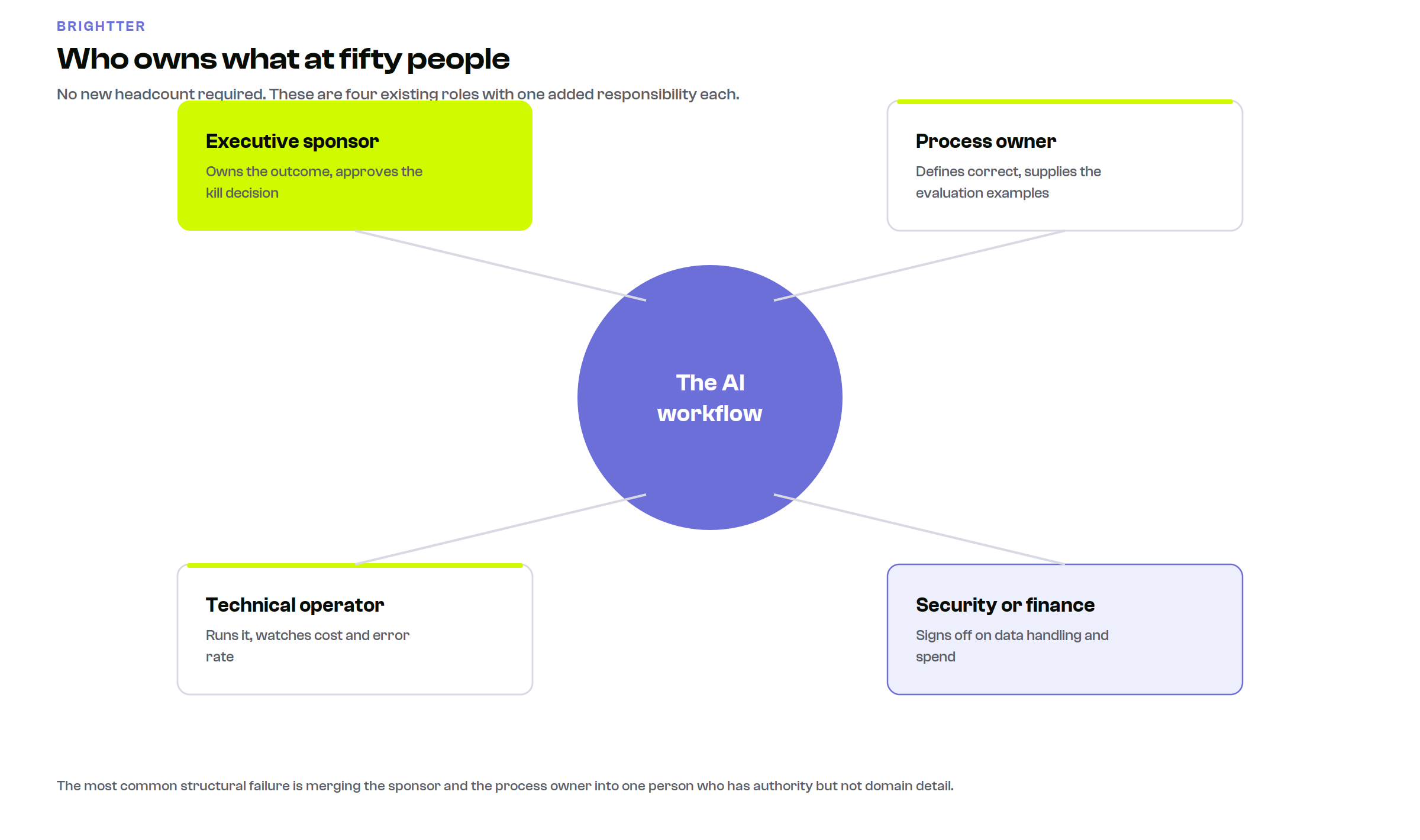
The executive sponsor owns the outcome and holds the authority to approve production deployment and to kill the project. This must be someone who will attend the reviews. A director who shows up is worth more than a VP who forwards the deck.
The process owner defines what correct means, supplies the evaluation examples, and adjudicates ambiguous cases. This is the person who actually does the work today, and they are the single most important participant — without them there is no evaluation set, and without an evaluation set there is no defensible system.
The technical operator runs the system, watches cost, error rate, and override frequency, and executes the regression run when a model version changes. Often a technically comfortable generalist rather than a full engineer.
Security or finance sign-off reviews data handling and spend once, at design time. This is a few hours, not a role, but it must have a name attached or it will happen at launch instead, when a finding is far more expensive.
The Merge That Kills Projects
One structural error is worth isolating because it is both the most common and the least recognized: merging the executive sponsor and the process owner into one person.
It happens for sensible reasons. At 50 people there is often one operations leader who both has authority and knows the process, and appointing them for both roles looks efficient.
The failure is subtle. That person now defines correct, supplies the evaluation examples, and approves whether the system meets the bar they set. There is no independent check, so the project drifts toward what that individual can personally verify — which is a much narrower target than what the workflow actually requires. Edge cases they do not personally handle go unrepresented in the evaluation set. The system passes review and fails in production on exactly the cases nobody was positioned to raise.
The separation matters more than the seniority. If you only have one candidate for both, the correct move is to push the process owner role down to the person doing the work daily, not to push the sponsor role up.
Four Things That Are Not Readiness
A data lake. Centralizing everything is an infrastructure program, not a readiness step, and it converts a tractable scoped problem into one that will not finish before the initiative's political capital expires. Fix access to the two or three sources one workflow needs.
An AI strategy document. A document describing where AI might apply across the business is a planning artifact, not a capability. It creates no readiness in any layer. One documented workflow with a measured baseline is worth more than a thirty-page strategy.
A platform subscription. Tools purchased before a workflow is defined get used for nothing in particular. Define the workflow, then choose tooling.
A newly hired head of AI. At 50 people this is usually premature and occasionally counterproductive: it concentrates responsibility in one person while the actual constraint — process documentation — sits with domain experts who now assume it is handled. Hire this role after you have shipped a workflow and know what you are scaling, not before.
The common thread is that all four are legible. They can be announced. The layers that actually constitute readiness cannot, which is precisely why they get skipped.
A Ninety-Day Path to Ready
For one well-chosen workflow, starting from nothing.
Weeks 1–2 — Select and scope. Choose a workflow that is high-frequency, has a measurable current cost, has recoverable errors, and has one person who genuinely wants it. Name the four roles. Write the success sentence and the kill criterion. Deliverable: one page, four names, one threshold, one date.
Weeks 3–5 — Externalize the process. The process owner writes the workflow down, including exceptions. Then hand it to someone who has never done it and record every question. This is the hardest and highest-value stretch, and it is where most of the ninety days is spent.
Weeks 4–6 — Fix data access, in parallel. Service credentials, programmatic reach, stable identifiers for the two or three sources involved. Runs concurrently with process work because different people do it.
Weeks 6–7 — Governance. Acceptable use, data-handling position, approved-tool list, review requirement. Security or finance signs off. Days of work; the calendar time is review latency.
Weeks 7–10 — Build the evaluation set and measure the baseline. Thirty to a hundred real examples labeled by the process owner, weighted toward hard cases and cases where the right answer is a refusal. Measure current time-per-task and current error rate. Without the baseline you cannot demonstrate improvement later.
Weeks 10–12 — Skills. The technical operator learns to run and monitor. The process owner learns to score against the rubric consistently.
At the end you have not built anything. You have made the build possible, and reduced it from an open-ended undertaking to a scoped one. Roughly eighty percent of that work is organizational.
Five Observable Tests
To check readiness without a consultant, answer these five. Each is verifiable rather than a matter of opinion.
1. Can someone pull the last hundred relevant records programmatically today, without asking a colleague?
2. Could a new hire execute the workflow from the written document, including exceptions?
3. Do you know how long the task takes today and how often it is wrong?
4. Can a named person score fifty outputs against a written standard and produce a percentage?
5. If it produced a wrong answer that reached a customer on a Friday afternoon, who is called?
Five yeses means ready for that workflow. Any no identifies your next piece of work, and the earliest no in the list is where to start.
The Brightter Perspective
The reason “AI-ready” stays undefined is that a real definition is uncomfortable. It reveals that the constraint is almost never the technology, which is the part everyone wants to talk about, and almost always the organizational work — writing things down, naming owners, measuring baselines — that is unglamorous and cannot be bought.
What we consistently see in the 25-to-200 band is that the technical portion of an AI project is the small, predictable part. The organizations that succeed are not the ones with better tools or larger budgets. They are the ones that were willing to spend three weeks writing down a process that had lived in someone's head for six years, and to name a single person accountable for the outcome.
That is genuinely good news, because it means readiness is not gated by capital or by hiring. It is gated by a decision to do specific unglamorous work in the right order.
At Brightter, we work through this stack from the bottom, and the most valuable output of an early engagement is frequently a written process and a scoped workflow rather than any software at all. The build is the part that reliably works.
Conclusion
AI-ready means five layers, in order: data a program can reach, a process written down with a measured baseline, governance that exists in writing, two or three people who can specify and evaluate, and one named person accountable for the outcome.
It is assessed per workflow rather than per company. It requires no new headcount — four existing people, one added responsibility each, and a deliberate refusal to merge the sponsor and the process owner. It is not a data lake, a strategy document, a platform, or a new hire, however much those resemble progress.
Run the five tests. Start at the earliest no. And expect that most of the work is writing things down, which is why it gets skipped and why the organizations that do it pull away from the ones that do not.
If you want to know whether you are ready for a specific workflow — and which layer is actually blocking you — that assessment takes days rather than months. Start a project at brightter.com/start-a-project.