.avif)

When to Use Claude vs. ChatGPT for Business Workflows
Key Takeaways
- A scorecard is the wrong artifact. Capability rankings between frontier models change every few months; the decision framework you use to choose between them does not. Build the framework, re-run it periodically
- The choice should be made per workflow, not per company. Which model is better is unanswerable. Which model should handle contract review, and which should handle customer-facing chat, is answerable
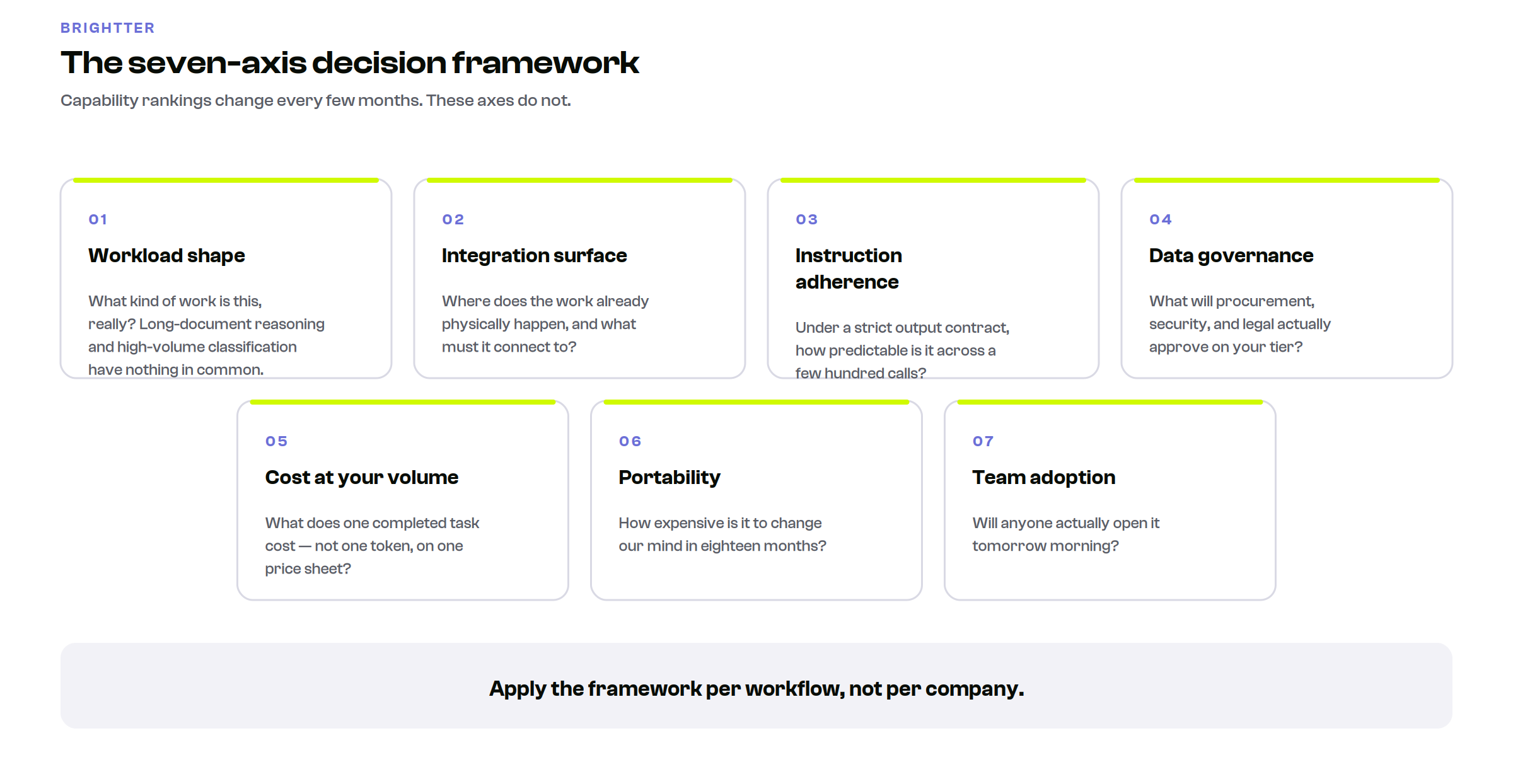
- Seven axes drive the decision: workload shape, integration surface, instruction adherence, data governance, cost structure at your volume, portability, and team adoption reality
- Most mature deployments run both. The interesting engineering question is not which vendor wins but how you build a thin abstraction layer so switching costs stay low
- Two axes are almost always underweighted: where the work physically happens and what your procurement and legal teams will actually approve
- Public benchmarks are close to useless for this decision. Twenty of your own real tasks, blind-graded against a written rubric, will tell you more than every leaderboard combined
- Assume you will migrate. Design for it: abstract the provider, externalize prompts, keep evaluations vendor-neutral, and never let a model-specific feature become load-bearing without a fallback
- Disclosure: Brightter is an Anthropic Claude Partner. This article is written as a decision framework, and the framework is designed to be applied honestly — including when it points away from Claude
Introduction: Why Comparison Tables Fail
Most Claude versus ChatGPT content is a table. Context window, benchmark scores, pricing, feature checkmarks. Those tables have a half-life of roughly two months, because both vendors ship continuously and leapfrog each other on most measurable dimensions.
More importantly, the table answers a question that does not matter to a business. Knowing which model scores higher on a graduate-level reasoning benchmark tells you almost nothing about which one should sit inside your contract review workflow, because contract review is not a benchmark. It is a specific task, on your specific documents, with your specific accuracy requirements, embedded in your specific systems, subject to your specific procurement constraints.
The durable artifact is a framework: a set of axes that determine which tool fits which job, applied to your actual workflows. The axes stay stable even as the models change underneath them.
What follows is that framework, the protocol for testing it against your own work, and an honest account of what genuinely does not matter as much as people think.
Axis 1: Workload Shape
Start by classifying the work, not the tool. Different categories of work have genuinely different requirements, and this is where the largest capability differences tend to show up.
Long-document reasoning. Contract analysis, policy review, multi-document synthesis, regulatory comparison, due diligence. The requirements are large context handling, faithfulness to source, and willingness to say that a document does not address something. Both vendors are competent here; the differentiator in practice is usually how each model behaves at the edge of its knowledge — whether it hedges, fabricates, or declines.
High-volume classification and extraction. Routing tickets, tagging records, pulling structured fields from unstructured text. Here the frontier tier is irrelevant. What matters is the cheapest model that clears your accuracy bar, latency, throughput limits, and batch pricing. This is a cost-engineering decision, not a capability decision.
Code generation and agentic engineering work. Both vendors invest heavily. The practical differentiator is less the raw model and more the surrounding agent tooling, terminal and IDE integration, and how the system behaves over long multi-step tasks.
Multimodal breadth. Image generation, voice, video understanding, and real-time speech vary meaningfully between vendors, and the gap here is usually wider than the gap on text reasoning. If your workflow needs image generation, that alone can decide the question.
Customer-facing conversation. Tone control, instruction adherence under adversarial input, refusal behavior, and consistency across thousands of interactions matter far more than peak reasoning ability. Test with your actual edge cases, including the hostile ones.
Research and synthesis with live sources. Both offer search-grounded modes. Evaluate citation quality and whether the system distinguishes what it found from what it inferred.
The point of this axis is simple: a company does not have one workload. It has six, and they do not all point the same direction.
Axis 2: Integration Surface — Where the Work Physically Happens
This axis is consistently underweighted and frequently decisive.
Ask where the work already lives. If your analysts spend their day in spreadsheets, an assistant that operates inside the spreadsheet is worth more than a marginally stronger model behind a separate chat window. If your engineers live in a terminal, terminal-native tooling wins. If your operations team lives in a chat platform, the tool that can be invoked there gets used and the one that requires a context switch does not.
Then ask what it needs to connect to. The integration story has consolidated significantly around the Model Context Protocol, which both major ecosystems now support, and that consolidation is genuinely good news: it means your integration investment is increasingly portable rather than vendor-specific. Evaluate the maturity of available connectors for your systems specifically, the authentication model, and whether administrative controls exist to govern which connectors a given team can enable.
A useful diagnostic question: if we adopt this, how many context switches does a typical task require? Every switch is adoption friction, and adoption friction is the single largest determinant of whether an AI deployment produces value.
Axis 3: Instruction Adherence and Behavioral Predictability
For anything embedded in an automated pipeline, predictability matters more than peak capability. Concretely, test:
- Format compliance. Given a strict output schema, how often does the model deviate? Measure it across a few hundred calls, not five.
- Negative instruction adherence. How reliably does it not do the thing you told it not to do? This is harder for models than positive instruction following and matters enormously in customer-facing contexts.
- Abstention behavior. When the answer is not in the provided context, does it say so, or does it produce something plausible? For document workflows this is often the single most important behavior, and it varies noticeably between models and between versions of the same model.
- Consistency across runs. Run the same input twenty times. Variance you can live with in a chat interface can be disqualifying in a pipeline.
- Robustness to adversarial input. For anything customer-facing, how does it handle attempts to override its instructions?
These are the properties that determine engineering cost after launch, and they almost never appear on comparison tables.
Axis 4: Data Governance and Procurement Reality
For many organizations this axis decides the question before any capability discussion begins, and it is better to establish it first than to discover it after a successful pilot. The questions to answer in writing, from vendor documentation rather than from a sales conversation:
- What is the default retention posture on your tier, and what changes on enterprise plans?
- Is your data used for model training, and is opting out contractual or configurable?
- What compliance certifications and regional data residency options exist, and do they cover the regions you operate in?
- Are zero-retention arrangements available for your use case, and what do they require?
- What administrative controls exist — SSO, audit logging, per-workspace policy, connector governance?
- What is the sub-processor list, and does your legal team accept it?
Two practical notes. First, these differ substantially between consumer, team, and enterprise tiers of the same vendor, so a comparison of consumer plans tells you very little about an enterprise deployment. Second, if you operate in a regulated industry, run this axis first. There is no point winning a capability bake-off that procurement will veto.
Axis 5: Cost Structure at Your Actual Volume
Cost comparisons based on headline per-token rates are usually misleading, because the shape of your workload matters more than the rate card. Three things to model:
Seats versus tokens. Assistant-style deployments for knowledge workers are priced per seat and scale with headcount. Embedded and automated workloads are priced per token and scale with volume. Most organizations end up paying for both, for different populations, and should budget them separately.
Token asymmetry. Output tokens typically cost several times input tokens across providers. A workload that reads a lot and writes a little has completely different economics from one that generates long documents. Estimate both directions from real samples.
The discount levers. Prompt caching, batch processing, and model tiering routinely change effective cost by a large multiple — often more than the difference between vendors. A team that routes classification work to the cheapest capable tier and caches its stable system prompt will spend dramatically less than a team running everything through the flagship model, regardless of which vendor they chose.
Tokenization is not identical across providers. The same text can produce meaningfully different token counts depending on the tokenizer, which means per-token rate comparisons alone can mislead by a noticeable margin. Measure cost per task on real samples, not cost per token from a price sheet.
Axis 6: Portability and Switching Cost
Assume you will change your mind. The frontier moves, pricing changes, and a workflow that made sense on one model last year may not next year. Design so that changing is a configuration decision rather than a rewrite:
- Abstract the provider behind a thin internal interface. Not a heavyweight framework — a thin one, that you control.
- Externalize prompts from application code, version them, and store them as data.
- Keep evaluations vendor-neutral. Your golden set and rubric should be portable and should be the artifact you re-run when you test an alternative.
- Flag model-specific dependencies. Any capability that exists on one provider and not another is a lock-in point. That may be an acceptable trade, but it should be a conscious one with a documented fallback.
The organizations that get stuck are not the ones that chose wrong. They are the ones that entangled a specific vendor's quirks into a hundred places in their codebase.
Axis 7: Team Adoption Reality
The last axis is the least technical and the most predictive of outcomes.
A slightly less capable tool that your team actually opens every morning outperforms a superior one they log into twice. Consider what your team already uses informally, which interface matches their existing habits, what training burden each option carries, and — for organizations where individuals have strong preferences — whether standardizing on one tool will produce quiet non-compliance.
There is a defensible middle path that many organizations land on: standardize the automated and embedded workloads on one provider for engineering and governance simplicity, and allow individual knowledge workers reasonable latitude in their personal assistant tool, within an approved list.
The Multi-Model Default
Follow the seven axes honestly and most organizations of any size arrive at the same conclusion: different workflows point to different tools, and the right architecture is not a single vendor but a routing layer. That layer is simpler than it sounds. It needs three things:
- A registry mapping workflow types to a designated model and tier
- A thin provider abstraction so the mapping is configuration, not code
- A shared evaluation harness that can run the same golden set against any provider
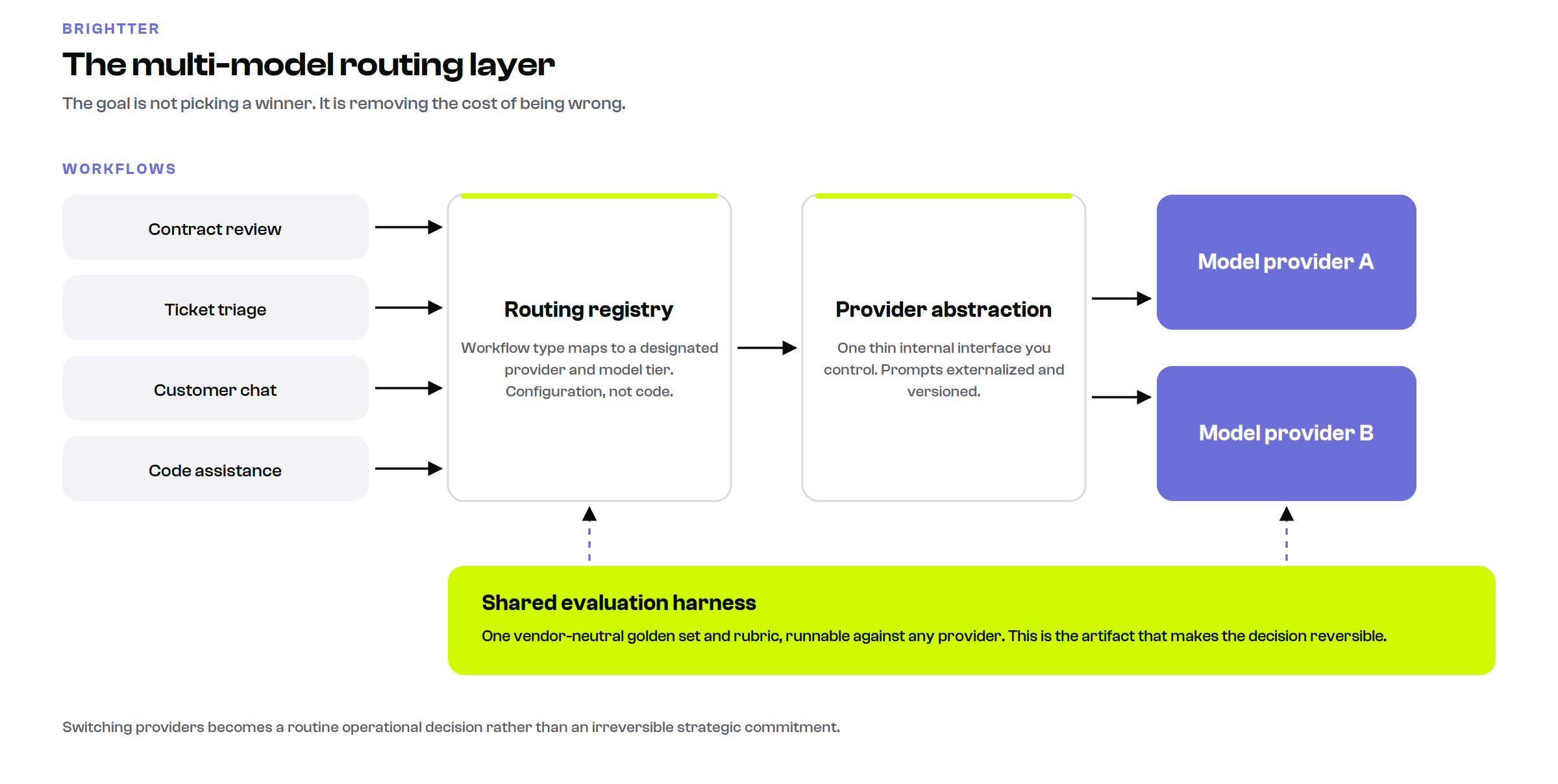
With those in place, the vendor question stops being an irreversible strategic commitment and becomes a routine, testable operational decision. That is the actual goal. Not picking a winner — removing the cost of being wrong.
How to Run a Real Bake-Off
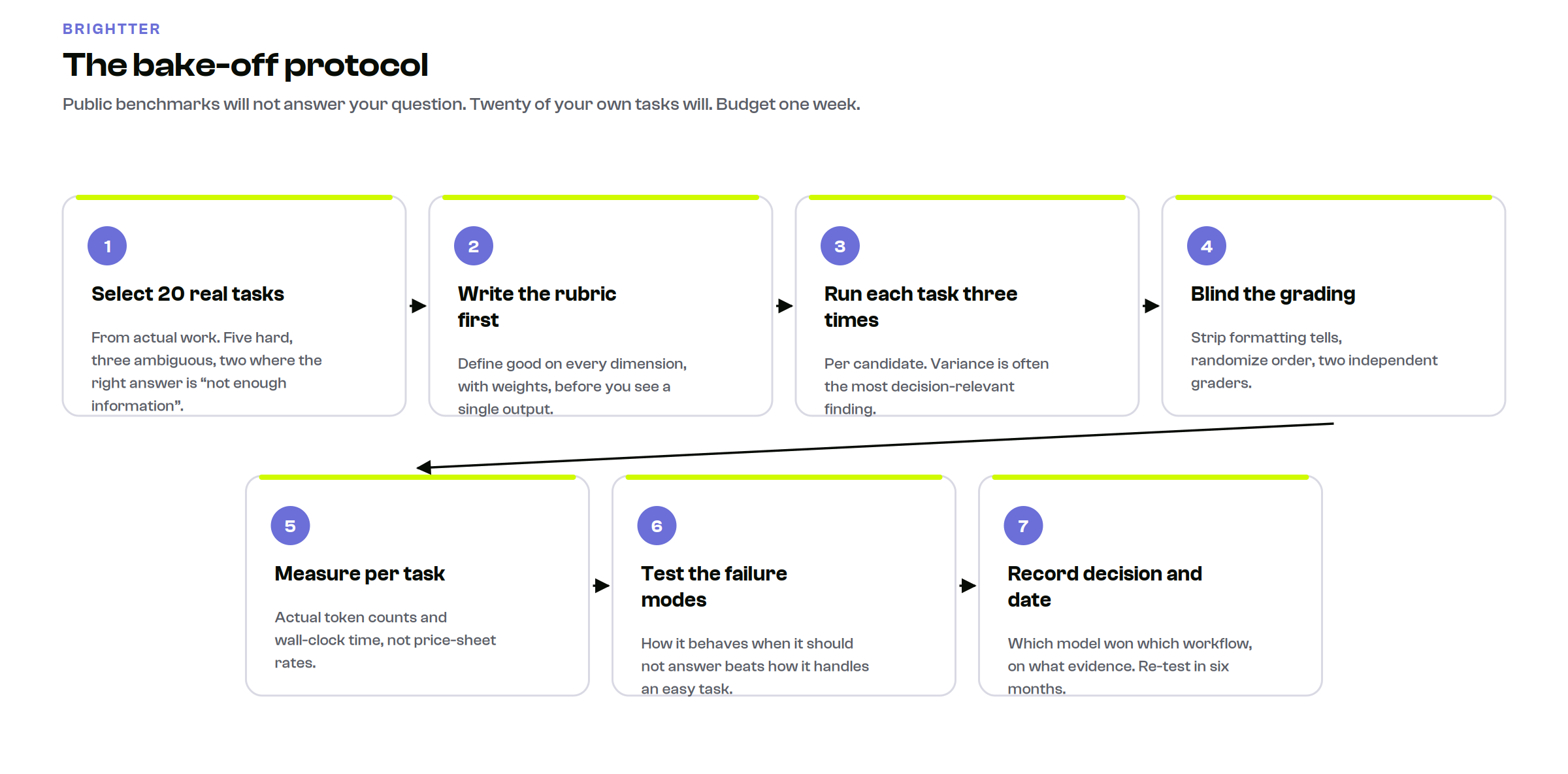
Public benchmarks will not answer your question. Here is a protocol that will, and it takes about a week.
1. Select twenty real tasks. Pull them from actual work your team has done. Include five that are genuinely hard, three that are ambiguous or underspecified, and two where the correct answer is that there is not enough information. Those last two are the most informative tasks in the set.
2. Write the rubric before you see any output. Define what a good answer looks like on each dimension you care about — accuracy, faithfulness to source, format compliance, tone, appropriate uncertainty. Assign weights. Writing this after seeing outputs guarantees you will rationalize a preference you already hold.
3. Run each task on each candidate, three times. Three runs surfaces variance, which is often the most decision-relevant finding and is invisible in a single pass.
4. Blind the grading. Strip identifying formatting quirks, randomize order, and have two people grade independently. Model preference is subject to substantial framing bias; blinding is not optional if you want a defensible result.
5. Measure cost and latency per task, not per token. Record actual token counts and wall-clock time for each run.
6. Test the failure modes deliberately. Feed each candidate the ambiguous tasks and the ones with insufficient information. How a model behaves when it should not answer tells you more about production suitability than how it behaves on a task it can do easily.
7. Write down the decision and the date. Record which model won which workflow, on what evidence, and schedule a re-test. Six months is a reasonable cadence given how quickly the landscape moves.
What Matters Less Than People Think
Leaderboard positions. Public benchmarks measure a narrow slice of capability under conditions unlike your workload, and the gaps between frontier models on most of them are smaller than the gap between a good prompt and a mediocre one.
Headline context window numbers. A very large advertised context window is not the same as reliable performance across that entire window. Test retrieval accuracy at the depth you actually need rather than trusting the specification.
Parameter counts and architecture details. Not disclosed reliably, not predictive of task performance.
Which model is smarter. Almost every business workflow is gated by integration, evaluation, data quality, and adoption — not by the marginal reasoning capability of a frontier model. Teams that spend three months choosing a vendor and one week on evaluation design have inverted their priorities.
Vendor roadmap promises. Evaluate what ships today. Roadmaps are not commitments.
The Brightter Perspective
We should be direct about our position: Brightter is an Anthropic Claude Partner, and we work with Claude every day. That is a reason to weigh our capability opinions carefully, and it is also why this article is a framework rather than a recommendation. A framework can be checked. A verdict cannot.
What we consistently see in practice is that the vendor question absorbs disproportionate attention while the decisions that actually determine outcomes — which workflows to automate first, how to evaluate whether the output is good, where a human stays in the loop, how integration and governance are designed — receive far less. Organizations that get those right succeed with either vendor. Organizations that get them wrong fail with both, and then conclude the technology was overhyped.
At Brightter, we help organizations pick the right workload to start with, design the evaluation that proves it works, and build the abstraction that keeps the vendor decision reversible.
Conclusion
There is no answer to Claude or ChatGPT. There is an answer to which model should handle this specific workflow, given our data constraints, our integration surface, our volume, and our team — and that answer is different for different workflows inside the same company.
Build the framework. Run the bake-off on twenty of your own tasks with a rubric you wrote in advance. Abstract the provider so the decision stays cheap to revisit. Then spend the time you saved on the things that actually determine whether the deployment works: evaluation, integration, and adoption.
The teams getting real leverage from AI are not the ones who picked correctly. They are the ones who made picking reversible.
If your organization is deciding where AI belongs in its workflows and how to prove it works, that assessment is where the effort pays off. Start a project at brightter.com/start-a-project.