.avif)

How to Tell Whether Your Workflow Should Be Automated, Augmented, or Left Alone
Key Takeaways
- There are four possible answers, not two: automate with a review gate, augment, document first, or leave it alone. Treating this as a binary is why so many builds are approved that should never have started
- Frequency dominates everything else by orders of magnitude. It is the numerator of every business case, and no amount of strategic importance compensates for a task that happens twice a month
- The dangerous zone is the middle. A task at roughly ten times a week looks plausible, gets approved, and produces annual savings smaller than its annual operating cost
- Ask the questions in order. Frequency, then documentation, then judgment, then recoverability. Each answer constrains what the next one can mean, and asking recoverability before judgment inverts the logic
- “Augment” is not a failed automation. It is frequently the correct permanent end state, reaches value faster, carries a far lighter governance burden, and generates the labeled data that any future automation would need
- Consequence means reversibility and blast radius, not how important the task feels to the person doing it. This single confusion misclassifies more workflows than any other
- Beware aggregating variants. Ten different request types at twenty a week each is not one workflow at two hundred a week; it is ten workflows, each below the threshold
- The answer has a shelf life. Volume growth, newly written documentation, and error instrumentation all move workflows between categories, so re-run the decision annually
Introduction: The Question Asked Too Late
Most AI projects are not chosen. They are inherited — from an executive who read something, a vendor demo that landed well, or a team member's enthusiasm. By the time anyone asks whether this particular workflow is a sensible thing to automate, a budget exists, a timeline has been communicated, and the question feels obstructive rather than useful.
That sequencing accounts for a large share of disappointing outcomes. The projects that fail are not usually built badly. They are built competently, on workflows that could not have repaid the effort no matter how well the build went.
This is a solvable problem, and the solution takes about an hour. Four questions, asked in a specific order, produce one of four answers. The framework is deliberately simple because it needs to be usable by someone who is not technical, in a meeting, before money is committed.
The uncomfortable part is that applied honestly, it will tell you not to build things you were excited about. That is the point. The cheapest AI project is the one you correctly decline.
Four Answers, Not Two
The conversation is usually framed as a binary — automate this or do not — which forces every candidate into a yes-or-no verdict and hides the two answers that are most often correct.
Automate with a review gate. The system processes items and a human reviews by exception, with confidence routing and sampled audits. Note the qualifier: unattended automation with no review is rare and should be earned through measured precision over time, not assumed at launch.
Augment. The model drafts, retrieves, or proposes; a human approves every item. Throughput improves, judgment stays human, and the governance burden stays low.
Document first. The workflow may well be a good candidate, but it exists only as accumulated judgment in someone's head. The specification is the project. Automation is a later phase.
Leave it alone. The honest answer for a large fraction of candidates, and the one that is hardest to say out loud once a budget exists.
Recognizing four options rather than two changes the character of the conversation. “No” sounds like a rejection of the whole idea. “Document first, then revisit in a quarter” is a plan.
The Four Questions, in Order
Order matters more than the questions themselves. Each answer constrains what the following ones can mean, and asking them out of sequence produces confidently wrong classifications.
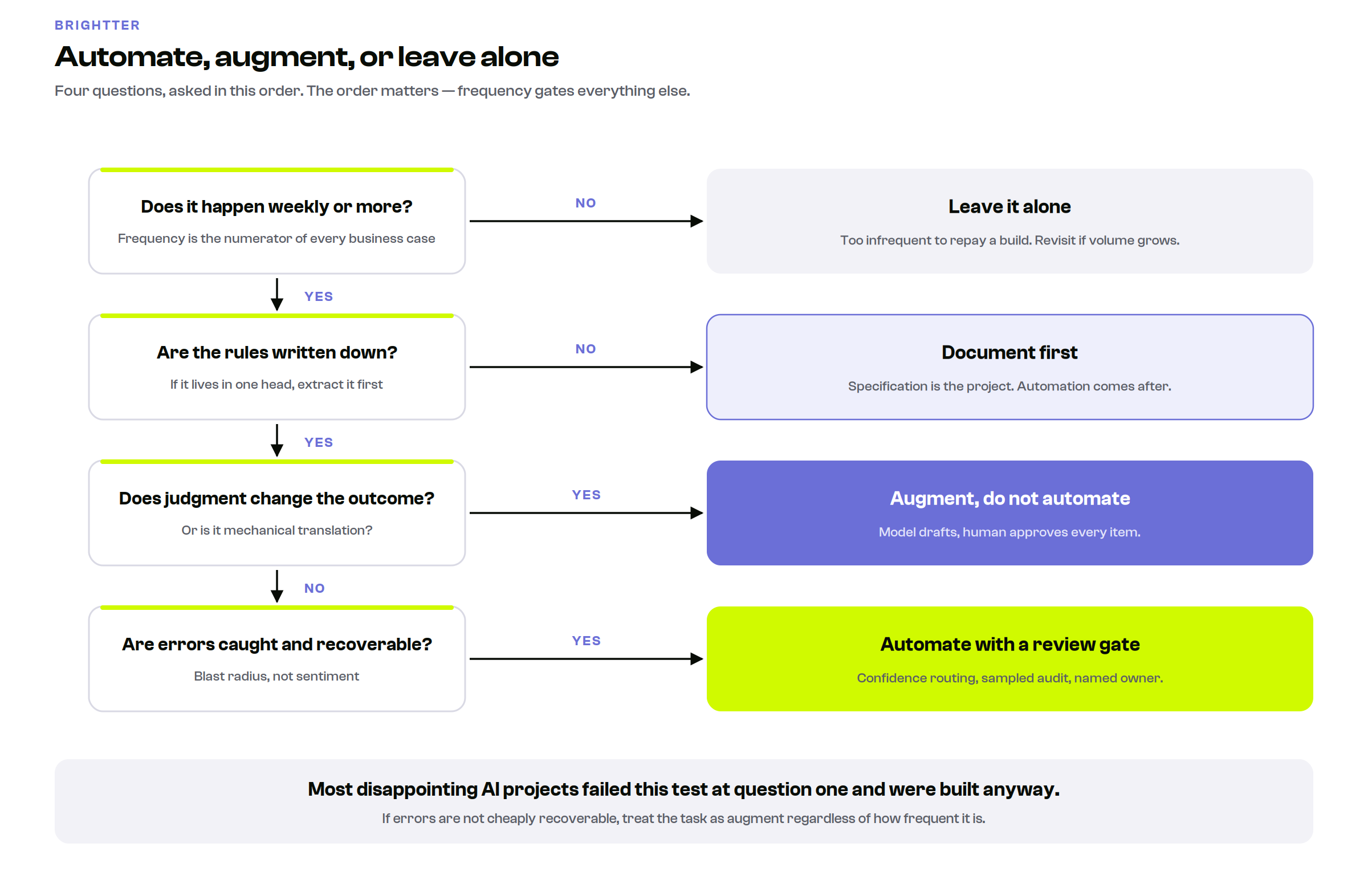
Question 1: Does it happen weekly or more?
Frequency first, because it is the only question that can disqualify a workflow on its own, and because the arithmetic is brutal in a way people consistently underestimate.
If no, leave it alone. Not later, not with a smaller build — leave it alone. A monthly task does not generate enough aggregate time to repay a build, an evaluation set, and a year of operations. Revisit if volume grows.
The resistance to this is always the same: but it is really important. Importance and frequency are different axes, and only one of them appears in the return calculation. An important quarterly task deserves a good checklist and an experienced person, not an AI system.
Question 2: Are the rules written down?
Only ask this once frequency has passed. If the workflow is frequent but undocumented, you have discovered your actual project.
If no, document first. Writing down a process that lives in someone's judgment is genuinely difficult work, cannot be delegated to a junior person, and routinely reveals that two departments have been doing it differently. It is also the highest-leverage thing you can do, because it is a precondition for evaluation, and without evaluation nothing downstream is provable.
The test: hand the document to someone who has never done the task. Every question they ask is a gap, and every gap would have become a defect.
Question 3: Does judgment change the outcome?
This is the question most often asked last and most often belongs third, because it determines whether a human must stay in the loop regardless of how good the system gets.
Judgment means the correct output depends on weighing factors that are not fully specified — reading a situation, applying discretion, deciding what a rule was for rather than what it says. It is distinct from complexity. A complicated but fully specified task is mechanical translation, and mechanical translation automates well.
If yes, augment. Not as a stepping stone — as the answer. The model drafts, the human decides.
Question 4: Are errors caught and recoverable?
Only reached by workflows that are frequent, documented, and mechanical. The final question is about consequence.
If yes, automate with a review gate. Confidence routing, sampled audit, a named owner.
If no, augment regardless of how frequent it is. A high-volume workflow whose errors are silent and irreversible is the worst possible automation candidate, precisely because volume multiplies the damage before anyone notices.
The Arithmetic of Frequency
Frequency deserves its own treatment, because the intuition is unreliable and the numbers are not close.
Take a task at fifteen minutes each, a loaded cost of $60 an hour, and assume automation removes 70% of the human effort — an optimistic figure once review time is counted.
Twice a month is 24 instances a year, 6 hours of work, 4.2 hours saved. Annual value: about $250. Against any build cost at all, this never repays. Not with a cheaper vendor, not with a simpler scope.
Ten times a week is 520 a year, 130 hours, 91 hours saved. Annual value: about $5,500. This is the dangerous case, because it sounds substantial. Against a $30,000 build it is a six-year payback before operations — and once you add the $8,000 to $10,000 of annual operations that a monitored workflow actually requires, the ongoing cost exceeds the annual saving. The system loses money every year it runs, forever.
Two hundred times a week at six minutes each is 10,400 a year, 1,040 hours, 728 hours saved. Annual value: about $43,700. Net of $10,000 operations, that is roughly $33,700 a year against a $40,000 build — a payback around fourteen months.
The span from the middle case to the third is a factor of eight in value, and it is driven almost entirely by frequency. This is why frequency is question one and why no amount of strategic importance rescues a low-frequency candidate.
It also explains a failure mode that looks like bad execution and is actually bad selection: the middle case gets approved because $5,500 a year sounds like a real number, and nobody subtracts operations. The project ships, works correctly, and quietly costs money.
Frequency Against Consequence
The four questions produce a verdict. The matrix below explains why, and is more useful for arguing the case to someone who was not in the room.
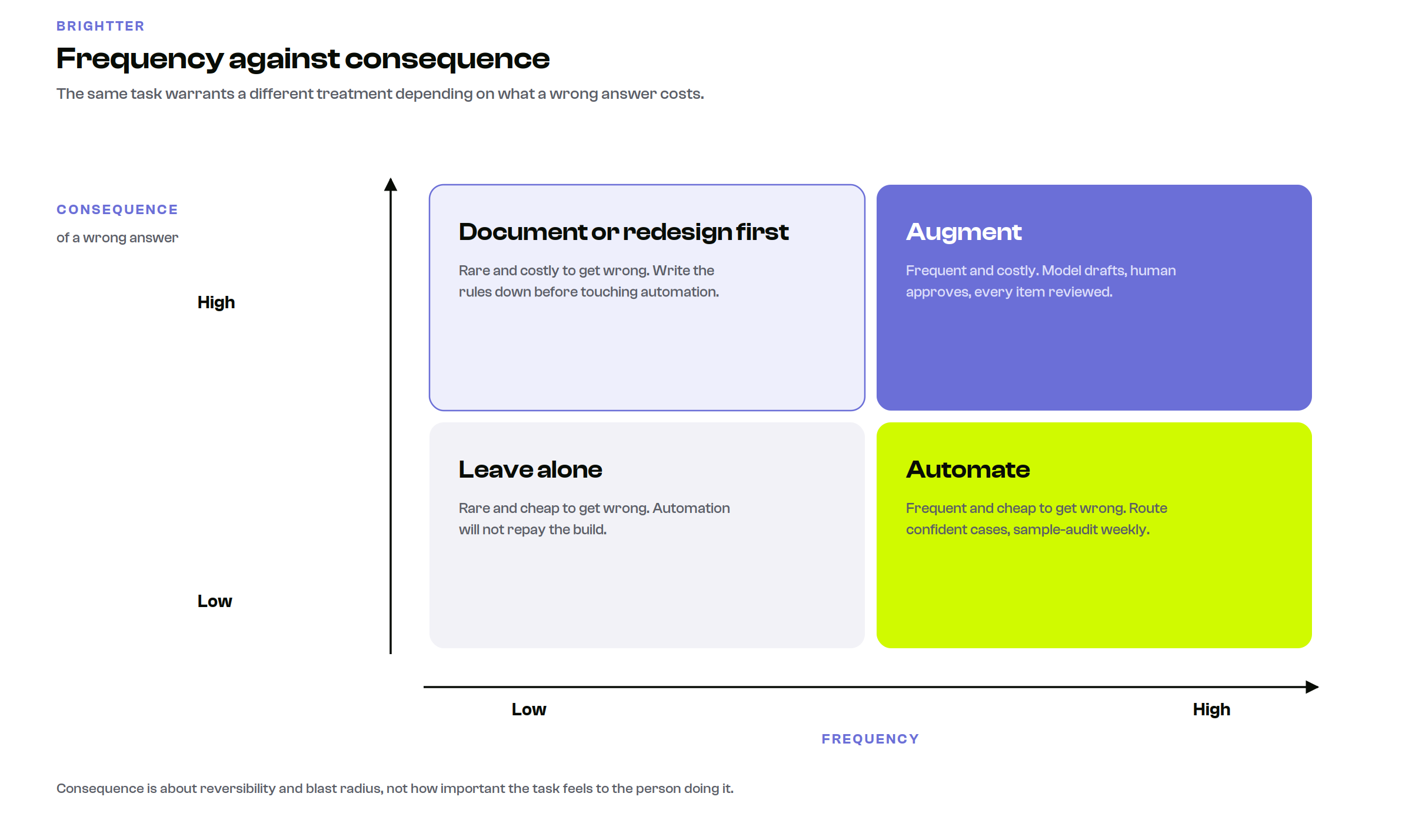
The axis that gets misread is consequence. Consequence means reversibility and blast radius — not how important the task feels to the person doing it.
A misrouted internal ticket is low consequence: someone notices within a day and reroutes it. A wrong figure in a document sent to a client is high consequence: it leaves your control, it is quotable, and correcting it costs more than the original task. The second may take less time and feel less significant to whoever does it.
Three questions establish consequence properly. Who sees the error first — an internal reviewer or a customer? How long until it is noticed — minutes, or the next audit? What does correction cost — a re-run, or a relationship?
An error caught internally within an hour is low consequence almost regardless of subject. An error that reaches a customer and is discovered in a quarterly review is high consequence even if the task is trivial.
Why Augment Is Undervalued
Teams treat augmentation as the consolation prize — what you settle for when full automation is not achievable. That framing costs real money, for four reasons.
It reaches value faster. An augmented workflow ships in a fraction of the time, because the review gate absorbs the reliability problem rather than requiring it to be solved before launch.
The governance burden is far lighter. A system that drafts for human approval writes nothing on its own, which keeps it out of the permission and audit requirements that gate autonomous systems. Frequently the difference between a six-week project and a six-month one.
It generates the data any future automation would need. Every human override is a labeled example. Six months of augmented operation produces an evaluation set richer than anything you could assemble deliberately, drawn from the real input distribution rather than from your imagination.
It is often the correct permanent answer. For workflows where judgment genuinely changes the outcome, the human is not a temporary scaffold. Treating augmentation as a stepping stone toward inevitable automation leads teams to under-invest in the review interface — which is the part that determines whether the thing gets used at all.
The useful reframing: augmentation moves the human from producing to deciding. That is a large throughput gain on its own, and it does not require the reliability guarantees that unattended automation does.
Four Common Misclassifications
Aggregating variants. The most consequential error in the whole exercise. A team counts two hundred inbound requests a week and concludes high frequency — but those are ten distinct request types at twenty a week each, with different rules and different exception patterns. That is ten workflows, each individually below the threshold. Before answering question one, ask how many genuinely different things are being counted, and whether one specification covers them all.
Automating work that should be eliminated. There is a zeroth option nobody offers. Some recurring tasks exist because of an upstream defect — a form that collects the wrong fields, a report nobody reads, a reconciliation caused by two systems that should be one. Automating these makes the defect permanent and cheaper to tolerate. Ask why the task exists before asking whether to automate it.
Confusing complicated with judgment-dependent. A task with forty steps and no ambiguity is mechanical and automates well. A task with three steps where the third requires reading a situation does not. Length is not the signal; specification completeness is.
Scoring importance instead of consequence. Covered above and worth repeating, because it is the most common single misread and it pushes workflows into augment that would have been fine to automate.
The Decision Has a Shelf Life
A verdict is accurate for the conditions under which it was made, and three things move workflows between categories.
Volume growth. A task at eight a week that reaches thirty is a different candidate. Any workflow declined on frequency should carry a review date and the volume threshold that would change the answer.
Newly written documentation. Everything blocked at question two becomes eligible once specified — and specification often happens for unrelated reasons, like onboarding or an audit. Keep the list of document-first workflows visible so that when the document appears, someone notices.
Error instrumentation. Consequence is partly a function of detection. A workflow whose errors were previously invisible becomes a much better automation candidate once you can catch them within an hour. Adding detection can move a task from augment to automate without changing the task at all — a genuinely underused lever.
Re-run the decision annually across your candidate list. It takes an afternoon and reliably surfaces two or three workflows that crossed a threshold without anyone noticing.
Applying This to a Portfolio
Run all your candidates through at once rather than evaluating them individually as they arise. Two things emerge that single-candidate assessment cannot show.
First, the frequency ranking rarely matches the enthusiasm ranking. The workflow everyone is excited about is frequently mid-table on the only axis that determines return, and seeing that in a sorted list is more persuasive than any argument.
Second, you find the boring candidate. Nearly every organization has one high-volume, well-specified, low-consequence workflow that nobody has proposed because it is unglamorous. That is almost always the right first project — not because its headline value is highest, but because its completion probability is, and the first completed workflow is what builds the evaluation infrastructure and internal confidence that make the next three cheaper.
The Brightter Perspective
The most valuable hour in an AI engagement is often the one where we talk a client out of the project they came in with.
That sounds like a sales problem and is the opposite. A workflow that cannot repay a build will not repay it for anyone, and the organization that discovers this after six months does not conclude that it chose badly — it concludes that AI does not work here. That belief is expensive, durable, and suppresses the next several proposals, including the good ones.
What we consistently find is that the same portfolio contains a workflow that would work. It is usually less interesting, higher volume, and proposed by nobody. Redirecting toward it is a better outcome for everyone than building the exciting thing competently and watching it fail on arithmetic.
At Brightter, we run this framework early and across a client's full candidate list rather than the single workflow they arrived with, because the sequencing decision is worth more than anything in the build.
Conclusion
Ask four questions in order. Does it happen weekly or more — if not, leave it alone, regardless of importance. Are the rules written down — if not, that is the project. Does judgment change the outcome — if so, augment, and treat that as the answer rather than a compromise. Are errors caught and recoverable — if so, automate behind a review gate; if not, augment however frequent it is.
Run the arithmetic rather than trusting intuition, and watch for the middle case where annual operations quietly exceed annual savings. Count variants separately. Ask why the task exists before asking whether to automate it. And put a review date on every no, because volume, documentation, and detection all change the answer over time.
The cheapest AI project is the one you correctly decline. The second cheapest is the boring one nobody proposed.
If you have a list of candidate workflows and want to know which one to build first, that is an afternoon of work and the highest-return decision in the entire program. Start a project at brightter.com/start-a-project.