.avif)
MCP Explained: The Integration Layer Behind Production AI Agents
Key Takeaways
- The Model Context Protocol (MCP) is an open standard that gives AI agents a universal interface to tools, data, and business systems, built on JSON-RPC 2.0 and inspired by the Language Server Protocol
- It uses a clean host, client, server architecture and three primitives: tools, resources, and prompts
- MCP turns the integration math from N times M into N plus M, collapsing custom-connector sprawl
- Introduced by Anthropic in November 2024, MCP surpassed 97 million monthly SDK downloads by early 2026, is supported by every major AI vendor, and was donated to the Linux Foundation's Agentic AI Foundation in December 2025
- Adoption is real but uneven: a 2026 survey found roughly 41 percent of software organizations running MCP in some form of production, with security as the leading blocker
- The security gap is concrete. Independent scans find 30 to 82 percent of public MCP servers carry exploitable flaws, and only a small fraction use authentication at all
- Enterprise readiness rests on a four-pillar security model plus an MCP gateway: zero-trust authentication, least-privilege binding, layered defense, and continuous monitoring
- MCP and A2A are complementary: MCP gives an agent its hands, A2A lets agents coordinate as a team
Introduction: The Integration Bottleneck That MCP Solved
For most of the last two years, the hard part of building useful AI was not the model. It was connecting the model to the systems where the work actually lives: the CRM, the ticketing system, the database, the document store. Organizations launched ambitious pilots only to discover that wiring AI into existing systems required time-consuming API work, brittle middleware, and specialized engineering. Every connection was a bespoke integration, written once for one model, and rewritten for the next.
The Model Context Protocol, or MCP, is the open standard that ended that pattern. Introduced and open-sourced by Anthropic in November 2024, it defines a single, consistent way for AI applications to discover and use external tools and data, so an agent can read a record, query a database, or file a ticket without a custom adapter for each model and each system. It has been nicknamed the USB-C of AI, and the comparison is apt: one connector shape, many devices. In roughly eighteen months it went from a single vendor's proposal to the de facto standard for AI agent integration.
This article explains the architecture, the integration math that makes it matter, why it reached critical mass so fast, the security reckoning that has accompanied that speed, the enterprise security model that addresses it, and how MCP relates to the agent-to-agent coordination layer emerging alongside it.
The Architecture: Host, Client, Server
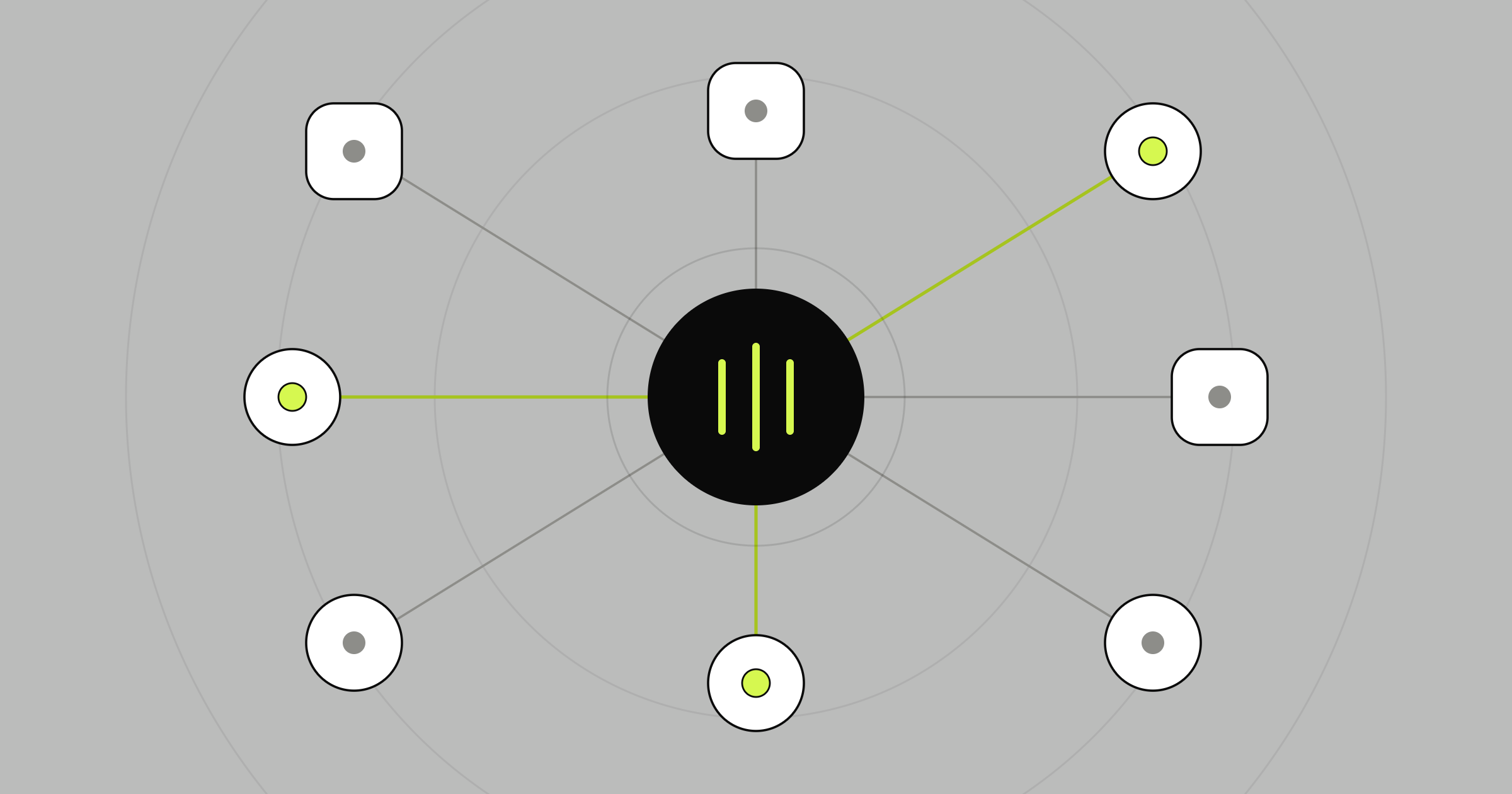
MCP uses a client-server architecture inspired by the Language Server Protocol, with JSON-RPC 2.0 as the underlying message format. There are three roles, and understanding the separation is the whole foundation.
- Host. The AI application the user interacts with, such as Claude Desktop, an AI coding tool, or a custom enterprise agent. It orchestrates the model and decides which capabilities the model may reach
- Client. A component embedded inside the host that speaks the protocol. A single host creates multiple isolated client sessions, each maintaining its own stateful JSON-RPC channel with one server
- Server. A lightweight process that exposes specific capabilities through three primitives: tools that perform actions, resources that provide read-only data, and prompts that offer reusable templates. A server might wrap a database, a file system, or a SaaS API
The flow of a single request is straightforward.
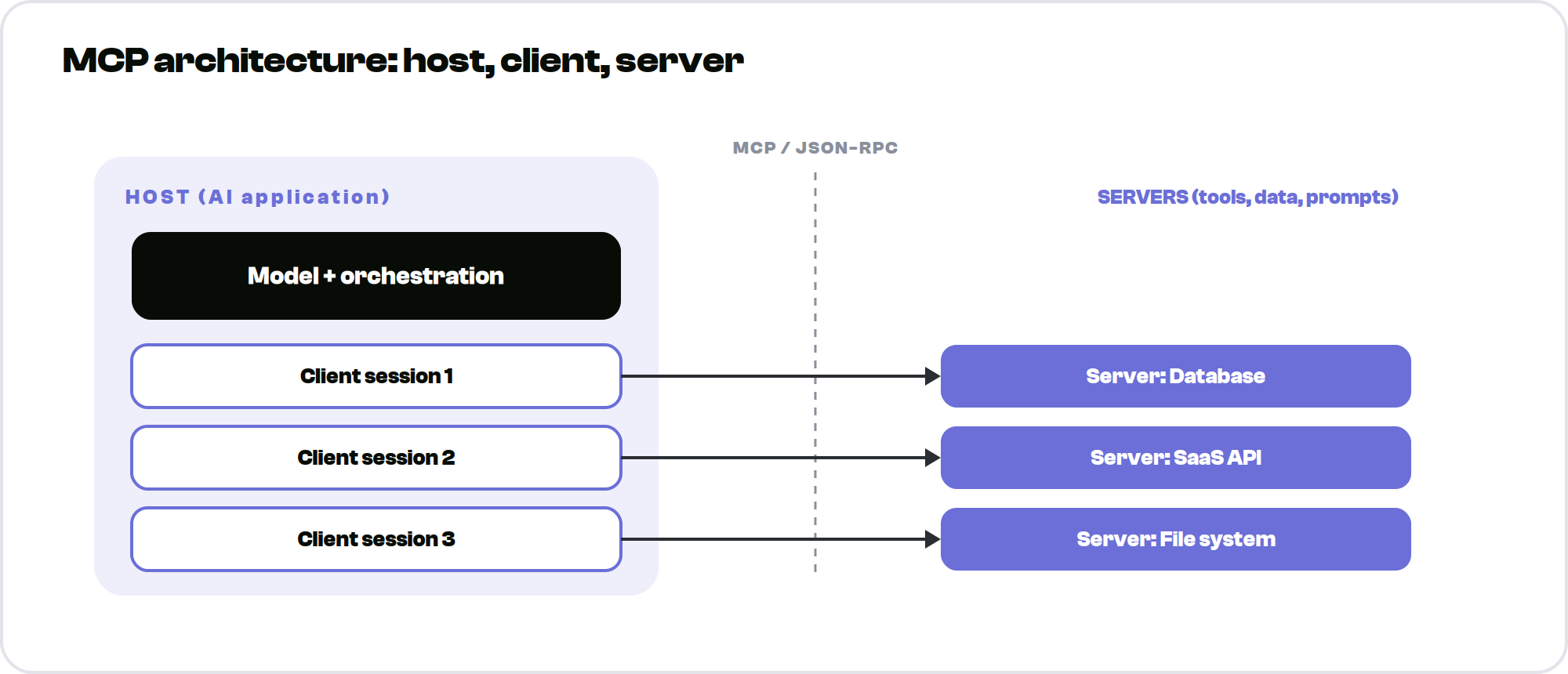
The model never needs to know whether a tool call hits a local database or a remote service. It sees a standardized capability and calls it. On the transport side, the protocol has matured: the modern stack uses Streamable HTTP, which is replacing the older server-sent-events approach, and remote servers adopted OAuth 2.1 as the authentication standard starting with the mid-2025 specification. That indirection and standardization are what make the whole ecosystem composable.
The Integration Math: From N Times M to N Plus M
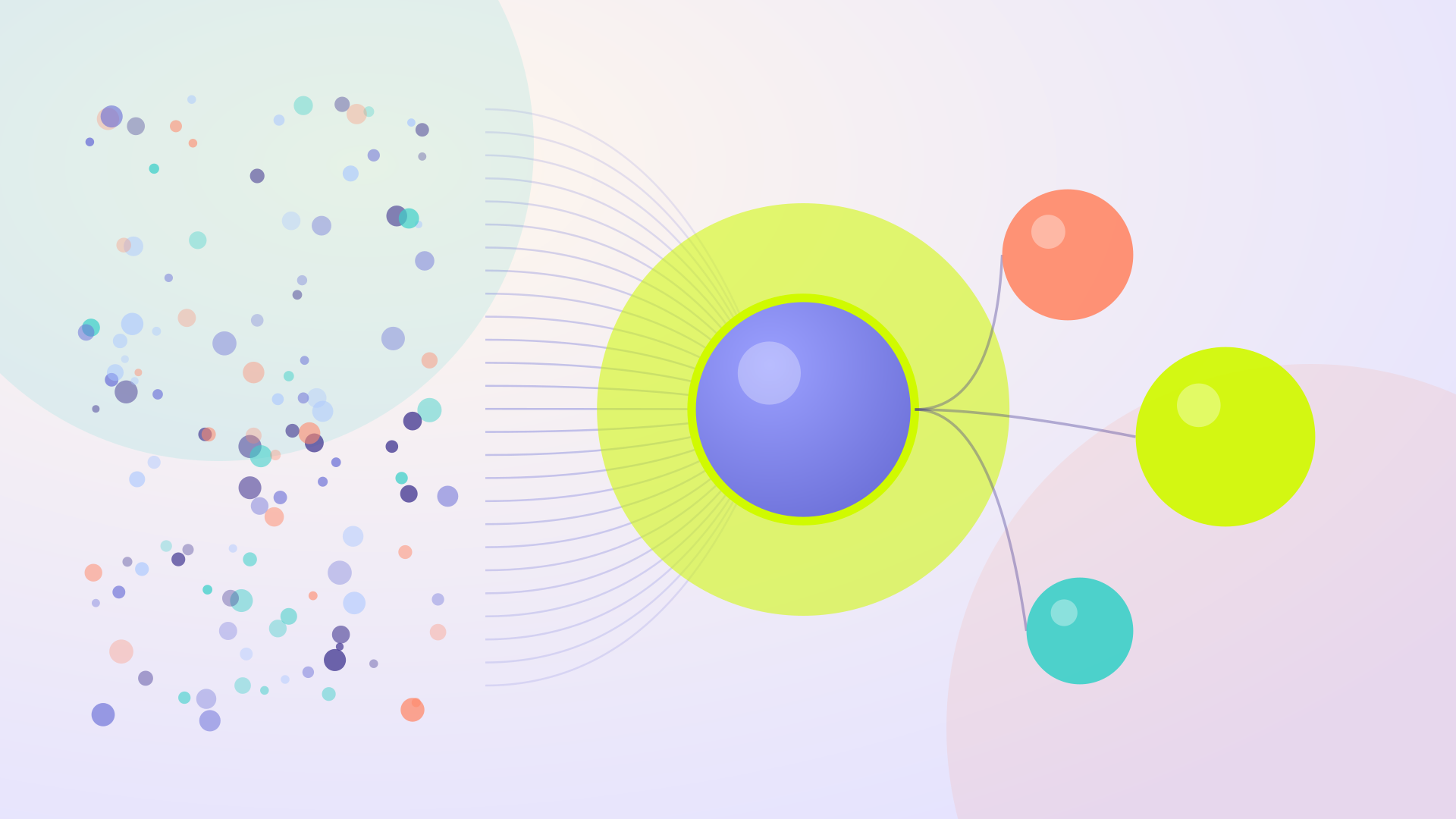
The clearest way to see why MCP matters is the integration arithmetic it changes. Before MCP, connecting AI to enterprise systems was a multiplication problem. With ten AI applications and one hundred tools, you potentially faced one thousand separate integrations, each one bespoke and each one a maintenance liability.
Before: 5 AI platforms × 20 business systems = 100 custom integrations
Every new AI tool meant rebuilding connections to every existing system, and every new system meant updating every AI integration. Technical debt accumulated faster than value. MCP turns the multiplication into addition:
After: 5 AI platforms + 20 business systems = 25 MCP servers and clients
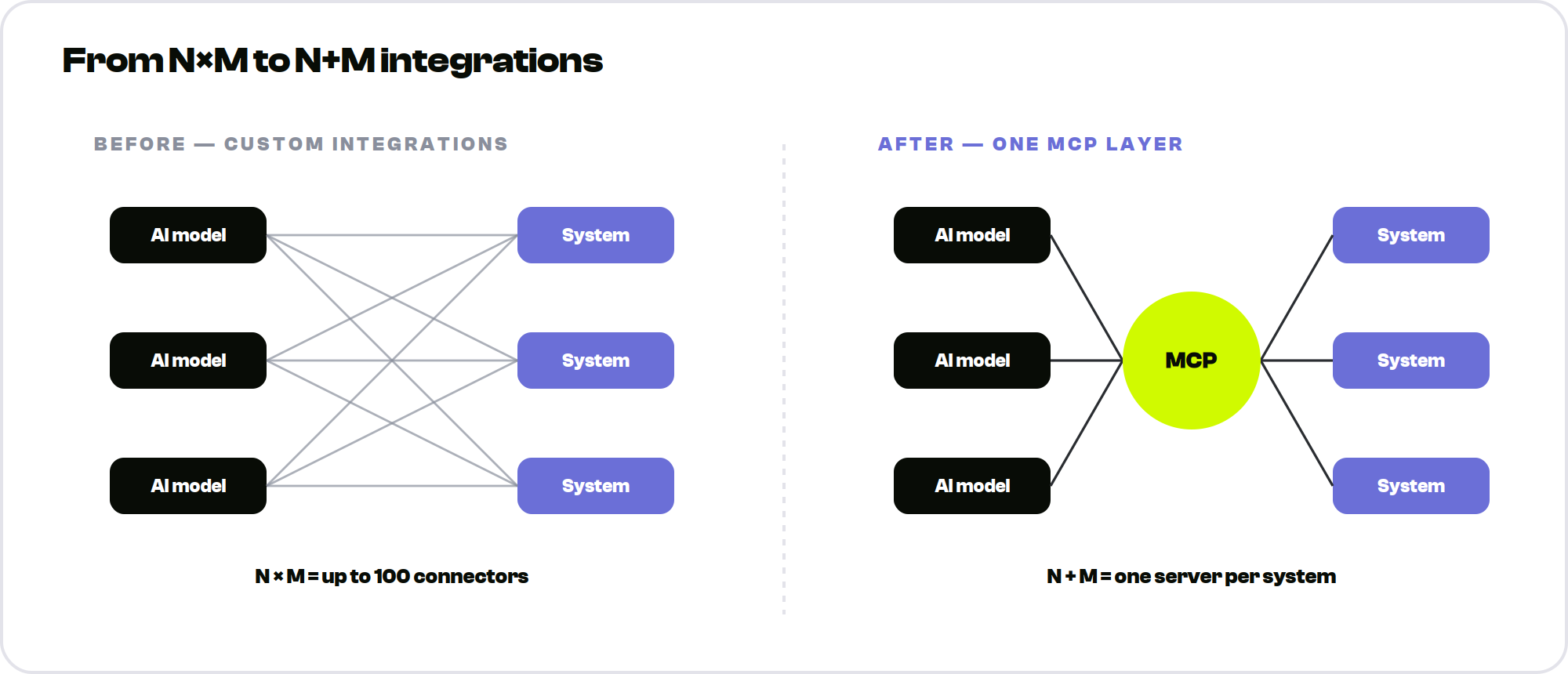
Build one server per system, and every compatible AI client can use it. Build one client per AI platform, and it can reach every server. The connector sprawl collapses, and the time to integrate a new tool drops from days of bespoke work to a fraction of that. This is the single utility that drove adoption: MCP lets you plug your existing stack of applications together without all of the annoying API integration work.
Why It Reached Critical Mass
Standards succeed on adoption, and MCP's has been unusually fast. Download volume tells the story: from roughly 100,000 in late 2024, to around 8 million by spring 2025, to more than 97 million monthly SDK downloads by early 2026, alongside tens of thousands of GitHub stars on the reference implementation. Every major AI vendor adopted it in turn through 2025, including OpenAI, Google, Microsoft, and AWS, and first-class client support now spans the most popular agentic coding tools and assistants.
The governance milestone matters as much as the metrics. In December 2025, Anthropic donated MCP to the Agentic AI Foundation, a directed fund under the Linux Foundation, with platinum backing from a roster that includes AWS, Anthropic, Block, Bloomberg, Cloudflare, Google, Microsoft, and OpenAI. For any organization making a long-term architectural bet, that move is decisive: the protocol is no longer a single vendor's project but vendor-neutral infrastructure stewarded the way Kubernetes and Node.js are. The public ecosystem now spans on the order of 10,000 active servers across developer tools and enterprise platforms.
Adoption is real but should not be overstated. The best-sourced enterprise survey in 2026 found roughly 41 percent of software organizations running MCP in some form of production, not the inflated figures that circulated earlier. The same research consistently identifies the same blocker: security. The protocol makes integrations easy, which is precisely why it also gives AI systems controlled access to sensitive systems, and that is where the hard part of 2026 lives.
The Security Reckoning
MCP's rapid proliferation outpaced the development of its security model. Much like early web protocols, it was released with a flexible, underspecified design that gave implementers freedom and also introduced ambiguity for safe usage. Critically, the protocol inverts a familiar pattern: instead of clients simply requesting data, MCP often expects servers to query and even execute actions for connected clients, which creates new and largely untraced attack paths. The consequences have been concrete and measurable.
Between January and February 2026, researchers and the community filed more than 30 CVEs targeting MCP servers, clients, and infrastructure. The most severe, a remote-code-execution flaw in a widely used MCP proxy package, carried a CVSS score of 9.6 and affected more than 437,000 installed environments; a separate unauthenticated-RCE issue in a popular MCP inspection tool scored 9.4. The first malicious MCP package appeared in September 2025, a poisoned build that silently exfiltrated every email it processed to an external domain and ran undetected for about two weeks. Real incidents in 2025 included cross-tenant data exposure and prompt-injection attacks against widely used servers.
The systemic picture is worse than any single CVE. Independent scans repeatedly find that 30 to 82 percent of public MCP servers carry exploitable flaws, that only a small single-digit percentage use OAuth, and that roughly a quarter have no authentication at all. Security researchers documented hundreds of MCP servers exposed to the open internet with zero authentication, tens of thousands of secrets leaked in public MCP configuration files, and a sharp surge in prompt-injection reports. A formal academic analysis went further, identifying three protocol-level weaknesses, the absence of capability attestation, sampling without origin authentication, and implicit trust propagation across multiple servers, and demonstrated that MCP's architectural choices amplified attack success rates by 23 to 41 percent compared with equivalent non-MCP integrations. These are architectural issues, not merely implementation bugs.
The institutional response signals how serious this is. National cybersecurity agencies published formal MCP security guidance in 2026, the MITRE ATLAS framework added agent-specific techniques such as context poisoning and memory manipulation, and MCP-related submissions dominated major security conferences, with the overwhelming majority focused on exposure rather than opportunity. The lesson for anyone deploying MCP is not that the protocol is unsafe to use; it is that security cannot be an afterthought.
The Four-Pillar Enterprise Security Model
Every tool an agent can reach is also a potential entry point into your systems, and an MCP server that aggregates credentials for many services becomes a high-value single point of failure. A sound enterprise deployment rests on four pillars.
- 1. Zero-trust authentication. No agent, user, or system is implicitly trusted. Remote servers should enforce OAuth 2.1 with PKCE, advertise their authorization server through well-known endpoints, and re-validate each tool call rather than relying on a long-lived token that could be hijacked
- 2. Least-privilege binding. An agent is granted only the minimum permission a specific operation requires. A read-only reporting task should never hold write permissions. A useful discipline is to align tools with data-classification zones, grouping public-data tools separately from those that touch sensitive or regulated systems
- 3. Multi-layer defense. Independent controls stack so that no single failure exposes everything: TLS with mutual authentication for server-to-server traffic, a tool-validation pipeline that screens tool descriptions and inputs for injection, response redaction that strips sensitive data, and credential storage in an enterprise vault rather than in config files
- 4. Continuous monitoring. Centralized logging captures every tool invocation, the agent identity, the parameters passed, and the response received. Shifts in unauthorized-attempt rates are early indicators of misconfigured permissions or emerging threats
The maturing enterprise pattern that ties these together is the MCP gateway: a managed layer that enforces single-sign-on authentication, granular policy, and audit trails across every agent-to-tool interaction. A practical rollout is phased, mirroring guidance now common across the industry: within 30 days, inventory existing MCP deployments, turn on audit logging, and centralize secret management; within 90 days, deploy the gateway and an approval process before any broad write access; within 180 days, establish full identity pipelines and a governance framework. It is the difference between a handful of ad hoc connections and a governed program you can defend in an audit.
MCP and A2A: Hands Versus Teamwork
A frequent point of confusion is the relationship between MCP and the agent-to-agent protocol, A2A. They are complementary, not competing, and the distinction is architectural. MCP defines how a single agent interacts with tools and data; it gives an individual agent its hands. A2A defines how separate agents coordinate, delegate, and share results; it lets a team of agents work together.
In a sophisticated system both operate at once. A coordinator agent uses A2A to delegate a sub-task to a specialist, and that specialist uses MCP to query the database or call the API it needs. A customer-support agent might pull account history over MCP, then hand a complex technical issue to another agent over A2A. The 2026 roadmap pushes this further: stateless server operation to enable horizontal scaling behind load balancers, and automatic discovery through server cards, which together evolve MCP from single tool connections into the foundation for multi-agent orchestration.
The Strategic Calculus for Leaders
For engineering and technology leaders, the strategic consequence is concrete. Instead of maintaining separate AI integrations for every model you evaluate or adopt, one well-designed server layer serves all of them, and the cost of switching or adding a model falls sharply. That is why MCP has moved beyond proof-of-concept environments into operational workflows: collecting data across systems for incident management, reading and triaging support tickets, and interconnecting security, logging, and file platforms.
The same surveys that show strong adoption also reveal a governance gap. Only a minority of organizations have a formal AI-agent identity strategy or a dedicated AI security governance team, and only a small fraction of agents reach production with full security controls. The combination of easy integration and expansive, non-deterministic permissions creates a risk profile most organizations have not previously managed at scale. The practical recommendation that follows is consistent across the field: adopt MCP as your default integration layer, and design security and governance from day one rather than retrofitting them after an incident.
The Brightter Perspective
Most AI initiatives stall at the same place: the model works, but wiring it to the systems where the business actually operates is slow, brittle, and rebuilt for every new tool. MCP removes that bottleneck, but only if the integration layer and its governance are designed deliberately rather than assembled connection by connection, because the same standardization that makes integration easy also concentrates risk.
At Brightter, we help organizations move AI from pilot to production by treating the connection layer as architecture: standardizing on MCP as the default integration surface, designing least-privilege access, gateway enforcement, and audit from day one, and composing agents and servers into workflows that are maintainable and defensible. The protocol is the enabler. The discipline around it is what makes the result trustworthy at scale.
Conclusion
MCP is the quiet infrastructure story behind production AI agents. It standardizes the messy, expensive integration layer, turns connector multiplication into simple addition, and, now backed by neutral governance under the Linux Foundation, has become durable infrastructure rather than a single vendor's bet. The open question of 2026 is no longer whether MCP works; it is whether organizations can operationalize it safely. With a sound four-pillar security model and a gateway in front of it, agentic systems can run on real business data with confidence, and paired with agent-to-agent coordination, MCP becomes the foundation on which multi-agent workflows are built.
If your organization is moving from AI experiments to agents that act on your systems, the integration and governance layer is where that effort succeeds or stalls. Start a project at brightter.com/start-a-project.