.avif)

Building a Claude Reasoning Layer Into an Outbound Pipeline
Key Takeaways
- A reasoning layer is the judgment stage of an outbound pipeline: it sits between enrichment and sequencing, and it answers questions that require reading, not questions that require filtering
- The single most useful design rule: if the condition can be expressed as a SQL WHERE clause, it belongs in SQL — headcount bands, geography, exclusion lists, and suppression are rules, not inference
- Never ask the model for a numeric score. Ask for categorical judgments on independent dimensions and compute the score in code, because LLM numeric outputs are poorly calibrated, unstable across runs, and impossible to audit
- Every output field should be enum-constrained, schema-validated, and paired with verbatim evidence from the retrieved context; a claim without a citable source snippet gets dropped, not retried
- The most expensive failure mode in AI outbound is not a mis-scored account. It is a confidently fabricated detail in a sent email, which is a brand liability rather than a metrics problem
- Give the model an explicit abstention option. A pipeline where the model can say insufficient evidence is dramatically safer than one where every record is forced into a tier
- Inference is rarely the dominant cost. With rule-based pre-filtering, model tiering, prompt caching, and batch processing, a 50,000-account monthly pipeline can run its reasoning layer for roughly $50 to $150 in tokens. The cost lives in data quality and engineering
- Ship with a 200-record golden set labeled by your best rep, measure precision at the top tier rather than raw accuracy, and treat abstention rate as your drift canary
Introduction: The Missing Middle of the Outbound Stack
The modern outbound stack is well served at both ends and thin in the middle. Sourcing and enrichment vendors are good at producing facts: firmographics, technographics, headcount trends, funding events, job postings, filings. Sequencing platforms are good at delivery: inbox rotation, warmup, deliverability management, reply detection, scheduling.
What sits between them is judgment. Given everything we now know about this account, does it actually match what we sell, and if so, what is the one true reason to reach out this week? For most teams that question is still answered either by a rep reading twenty browser tabs, or by a point-scoring rule that was written eighteen months ago and has never been revisited.
That gap is where a reasoning layer belongs. It is a discrete, well-bounded stage in the pipeline where a language model reads unstructured evidence and emits a structured judgment. Done properly, it is one of the highest-leverage places to put an LLM in a go-to-market system, because the input is abundant, the output is small and checkable, and the downstream consumer is a machine rather than a human reading prose.
Done improperly, it becomes an expensive random number generator that no one trusts and everyone eventually turns off.
This article covers the architecture: where the reasoning layer sits, what its output contract should look like, why categorical judgments beat numeric scores, how to ground claims so the pipeline cannot fabricate personalization, and where deterministic rules simply outperform the model.
The Five-Stage Architecture
A reasoning layer only works if it has exactly one job and receives only verified inputs. The pipeline that supports it has five stages, and the boundaries between them matter more than the internals of any one stage.
1. Sourcing. Define the universe. This is a query, not a judgment: industry codes, headcount bands, geography, technology presence, exclusion of existing customers and active opportunities. Output is a list of account identifiers.
2. Enrichment. Retrieve facts about each account from vendors and public sources. Firmographics, funding history, leadership changes, open roles, public filings, product documentation, careers pages. Output is a structured record plus a bundle of unstructured text.
3. Signal detection. Identify events that create timing relevance: a new executive in a relevant function, a hiring pattern, a stated initiative, a compliance deadline, a public commitment. Most signal detection is pattern matching over structured events and belongs in code. A small subset — reading a job description and deciding whether it implies the problem you solve — belongs to the model.
4. Reasoning layer. The model reads the assembled record and emits a structured judgment: fit assessment across defined dimensions, the strongest supporting evidence, the single best outreach angle, and an explicit confidence or abstention.
5. Sequencing. Deterministic delivery. Route by tier, assign owner, select template family, enforce suppression and frequency caps, schedule.
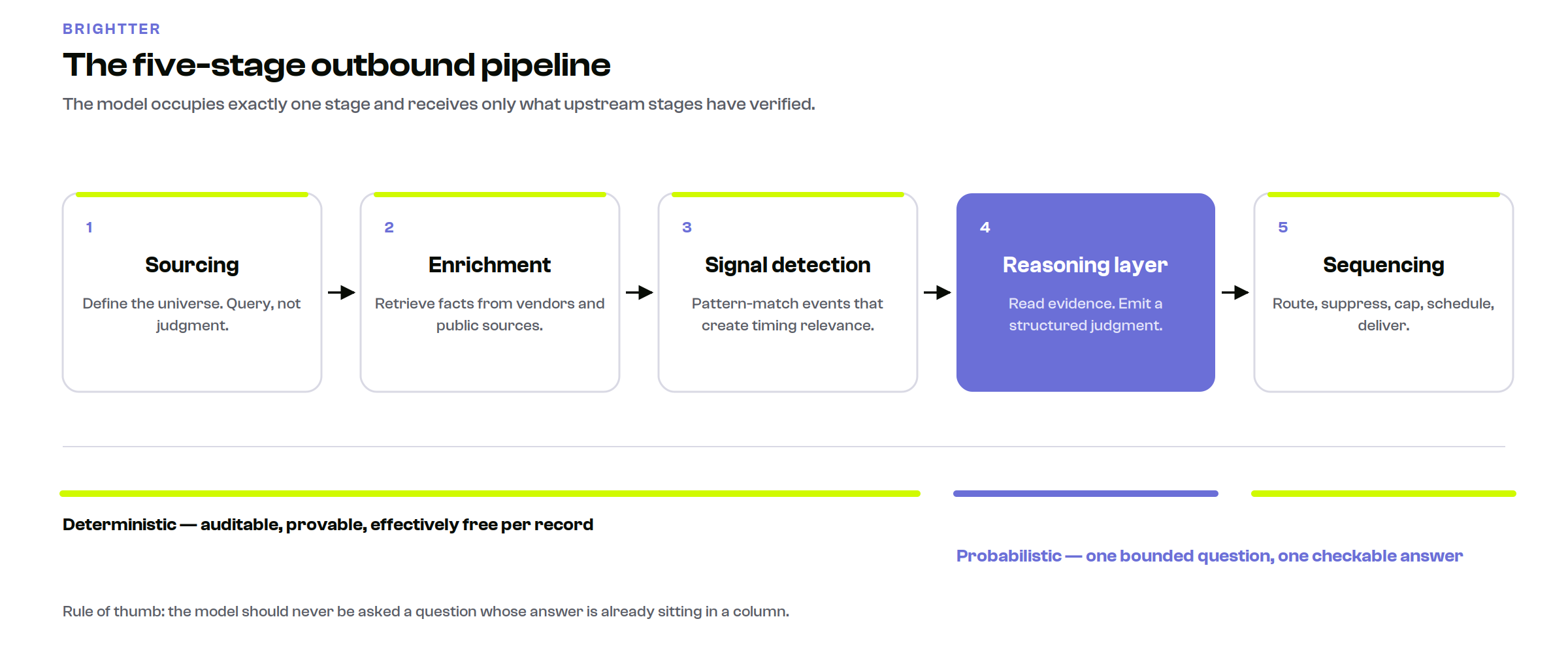
The critical discipline is that stage four receives a clean, bounded, pre-filtered record. If you send raw scraped HTML and 40,000 tokens of vendor JSON into the model and ask it to figure things out, you will get high variance, high cost, and low auditability. The reasoning layer should read a curated brief, not a data lake.
Where Deterministic Rules Beat the Model
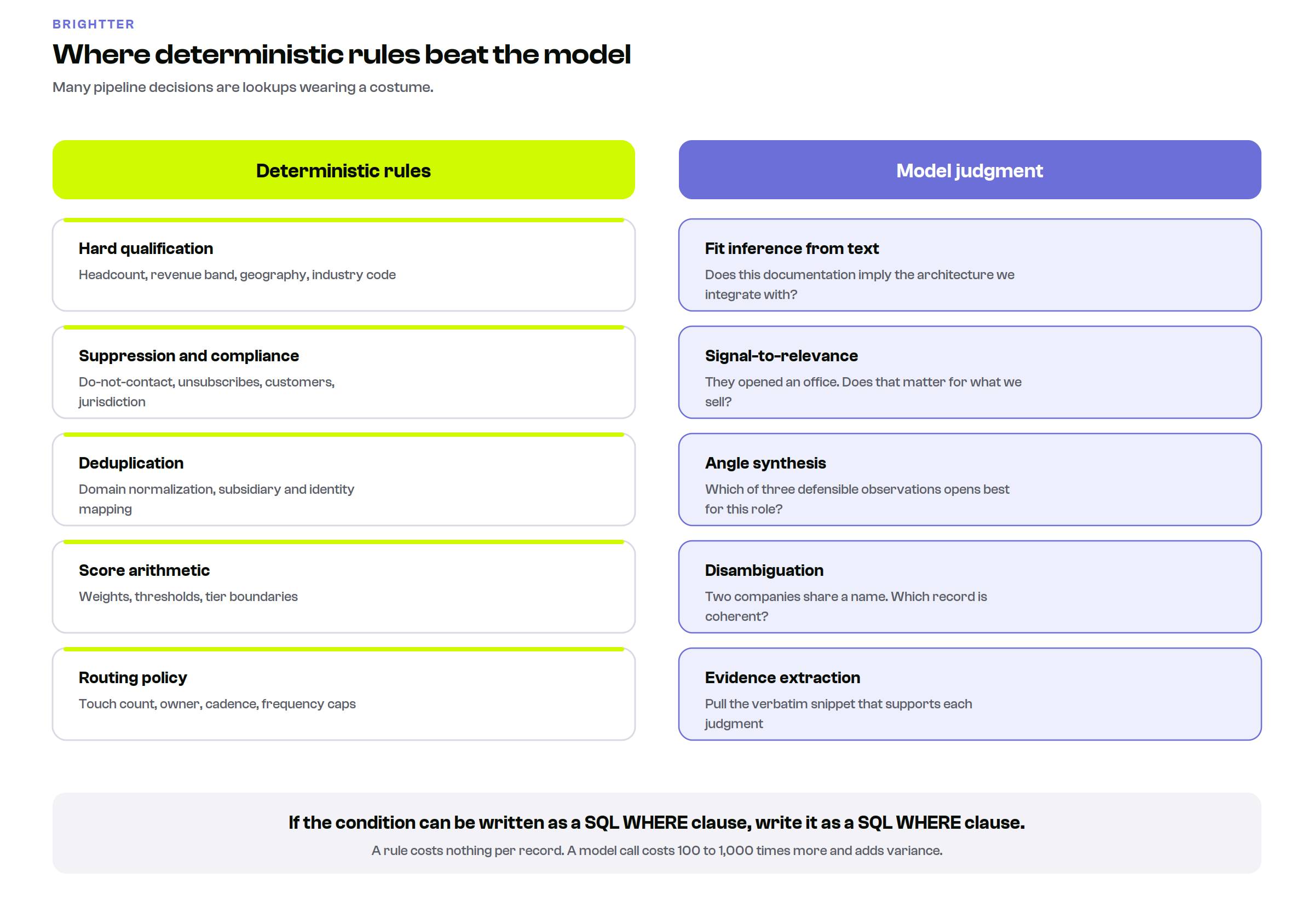
This is the section most teams skip, and skipping it is why their pipeline is expensive and inconsistent. Not every decision in the pipeline is a reasoning problem. Many are lookups wearing a costume.
Rules win when the criterion is objective, stable, and auditable:
- Hard qualification. Headcount range, revenue band, country, industry classification, entity type. The answer is in a field. The model adds variance and cost while producing a worse answer than a comparison operator.
- Suppression and compliance. Do-not-contact lists, unsubscribes, active customers, open opportunities, competitor domains, jurisdictional restrictions. These must be provable and deterministic. A probabilistic system deciding who is legally contactable is an unacceptable design.
- Deduplication and identity resolution. Domain normalization, subsidiary mapping, contact-to-account association. Deterministic with a fuzzy-match fallback, never free-form inference.
- Score arithmetic. Turning judgments into a ranked number, applying weights, applying thresholds. Code.
- Frequency and routing policy. How many touches, from whom, in what window. Code.
The model wins when the criterion requires reading and interpretation:
- Fit inference from unstructured text. Does this company's product documentation imply the architecture we integrate with? Does this job posting describe the pain we solve, or a superficially similar one?
- Signal-to-relevance mapping. They opened an office in a new region. Does that matter for what we sell, and why?
- Angle synthesis. Given three defensible observations, which single one is the most compelling opening for this specific buyer role?
- Disambiguation. Two companies share a name; the evidence bundle is mixed. Which record is coherent?
There is also a cost argument that reinforces the same boundary. A rule evaluates in microseconds for effectively zero marginal cost. A model call costs somewhere between a tenth of a cent and several cents and takes seconds. Every deterministic filter applied before the model call reduces inference spend proportionally. A pipeline that filters 50,000 accounts down to 8,000 before its first model call is not just cheaper; it is faster to iterate on, because your evaluation set is smaller and more relevant.
The rule of thumb worth internalizing: the model should never be asked a question whose answer is already sitting in a column.
Designing the Output Contract
The output contract is the most important artifact in the entire layer. It is the interface between a probabilistic component and a deterministic system, and it is where most implementations go wrong. Four principles govern it.
Constrain every field to an enum or a bounded type. Free-text fields are where drift enters the system. If the downstream consumer branches on a value, that value must come from a closed set. A fit tier of strong, moderate, weak or insufficient evidence is testable. A free-text assessment saying it looks like a pretty good fit overall is not.
Require evidence for every judgment. Each dimension should carry a verbatim snippet from the supplied context and an identifier for its source. This does two things: it makes the output auditable by a human in seconds, and it makes fabrication mechanically detectable, because you can string-match the snippet against the source document.
Include an explicit abstention path. The model must be able to decline. Most qualification prompts implicitly force a choice, which converts uncertainty into a confident wrong answer. An insufficient-evidence tier, with a required missing-information field, converts the same uncertainty into a routing decision — send it back for enrichment, or drop it.
Version the contract. Every emitted record should carry the prompt version and schema version that produced it. Without this, you cannot interpret a change in tier distribution three months from now, and you cannot compare reply rates across prompt revisions.
A workable shape carries a schema version, a prompt version, the account identifier, a dimensions object holding one judgment plus evidence plus source ID per dimension, a recommended angle with its rationale and supporting evidence, a disqualifiers array, a confidence value, and a missing-information array. Note what is absent: there is no score. That is deliberate.
Why You Should Not Ask the Model for a Score
Asking a language model to return a fit score from 0 to 100 is the single most common design error in this category, and it fails for four independent reasons.
Calibration. LLM numeric outputs cluster. Ask for 0 to 100 and you will get a distribution heavily concentrated between 65 and 85, with the interior of that range carrying almost no information. The model is not estimating a probability; it is producing a plausible-looking number.
Stability. The same record scored twice can differ by several points. Across a prompt revision, the entire distribution can shift. You cannot tell whether last quarter's average score of 74 and this quarter's 81 reflect a better pipeline or a reworded instruction.
Non-decomposability. When a rep asks why an account scored 82, there is no answer. The number is atomic. It cannot be traced, argued with, or corrected.
Inflexibility. If you decide that timing signals should count for more than technical fit, a model-produced score requires re-running inference across your entire universe. A computed score requires changing a constant.
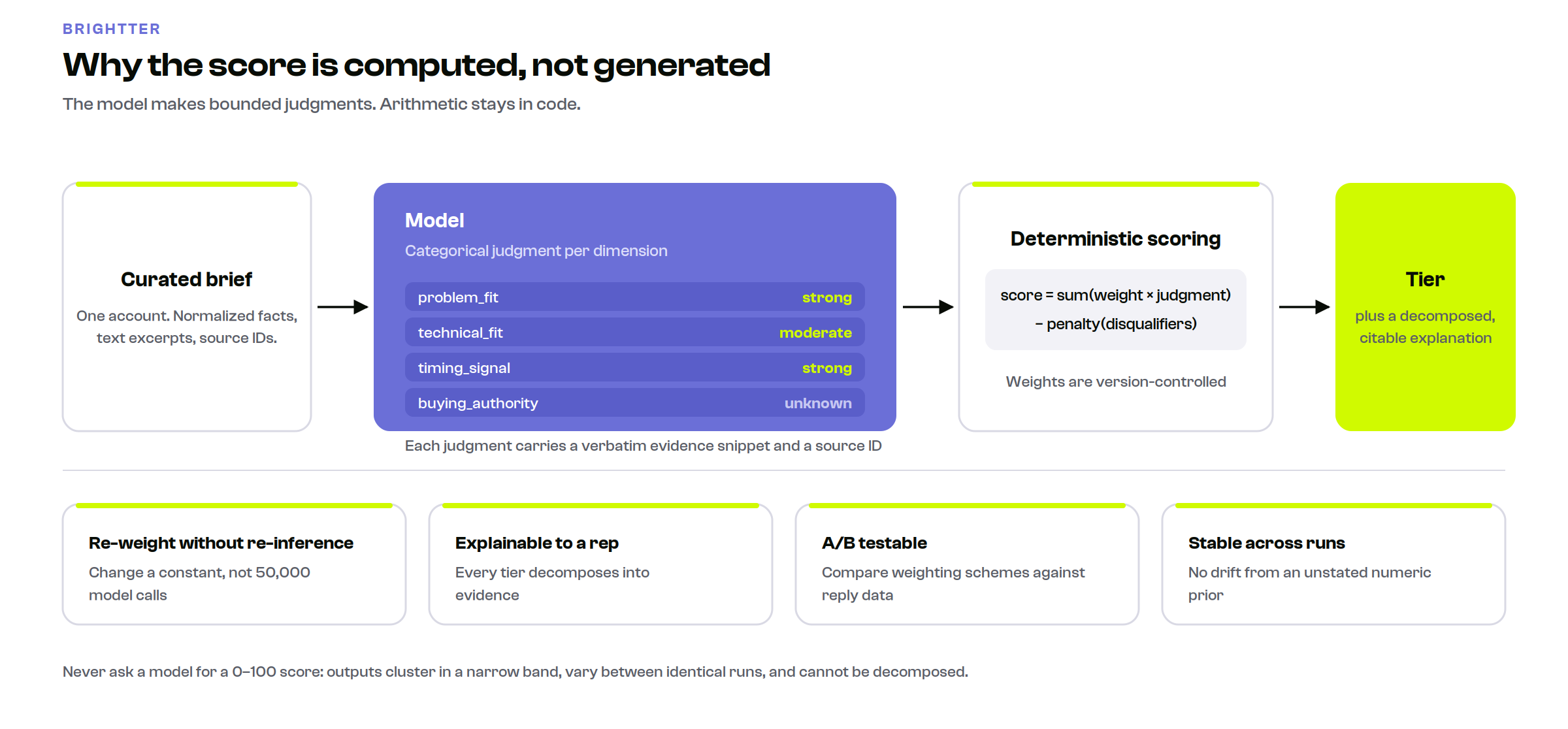
The alternative is straightforward and strictly better. Ask the model for independent categorical judgments on each dimension, each grounded in evidence. Then compute the score in code as the sum of each weight multiplied by its judgment value, minus a penalty for any disqualifiers.
This gives you four properties the model cannot: the weights are visible and version-controlled; you can re-weight historical records without new inference; you can A/B test weighting schemes against reply data; and every score decomposes into a human-readable explanation with citations attached.
The model does what it is good at — reading evidence and making bounded judgments. Arithmetic stays in the deterministic layer where arithmetic belongs.
Grounding: Preventing Fabricated Personalization
The failure mode that actually damages a business is not a mis-tiered account. It is an email that confidently references a funding round that never happened, a product the company does not sell, or an executive who left two years ago. One of those in a prospect's inbox costs more than a hundred missed opportunities, because it is visible, quotable, and forwardable.
Four controls, layered, reduce this to near zero.
Closed-world instruction. The prompt must state explicitly that the model may only use facts present in the supplied context, and that any claim not supported by the context must be omitted rather than inferred. This is necessary but not sufficient on its own.
Mandatory evidence fields. Every generated claim carries a verbatim snippet. This is the enforcement mechanism, not a nicety.
Programmatic verification. After generation, check each evidence snippet against the source text with a normalized substring or high-threshold fuzzy match. If the snippet does not appear in the source, the record fails validation. This is a cheap deterministic check that catches the overwhelming majority of fabrication, and it costs nothing per record.
Fail closed, do not retry into plausibility. When verification fails, drop the record to a review queue. Do not re-prompt until the output passes, because that process selects for outputs that look correct rather than outputs that are correct.
A useful mental test for any generated sentence: could a reader disprove this with a thirty-second search? If yes, and the claim is not backed by a verified snippet, it should not have been generated.
Prompt Architecture and Caching
Structure the call so the expensive part is stable and the variable part is small.
System prompt carries policy. The ideal customer profile definition, the dimension rubric with explicit criteria for each categorical value, the disqualifier list, the output schema, and three to five worked examples. This block is long — often two to four thousand tokens — and it should be byte-identical across every call in a run.
User message carries the record. The curated brief for one account: normalized firmographics, the relevant text excerpts, detected signals, source identifiers.
That separation exists for a technical reason. Prompt caching charges cache reads at a small fraction of the base input rate, so a stable prefix that would otherwise dominate your token bill becomes nearly free after the first call. The economics reward exactly the architecture that also produces the most consistent outputs.
Process one record per call. Batching ten accounts into a single prompt is tempting and consistently produces worse results: judgments bleed across records, later items receive less careful treatment, and a single schema violation invalidates the whole batch. One record per call, parallelized, with caching, is both more accurate and — after cache hits — not meaningfully more expensive. For non-interactive runs, the Batch API applies a substantial discount for work that tolerates asynchronous completion, which describes nearly all outbound qualification.
Model Tiering and What This Actually Costs
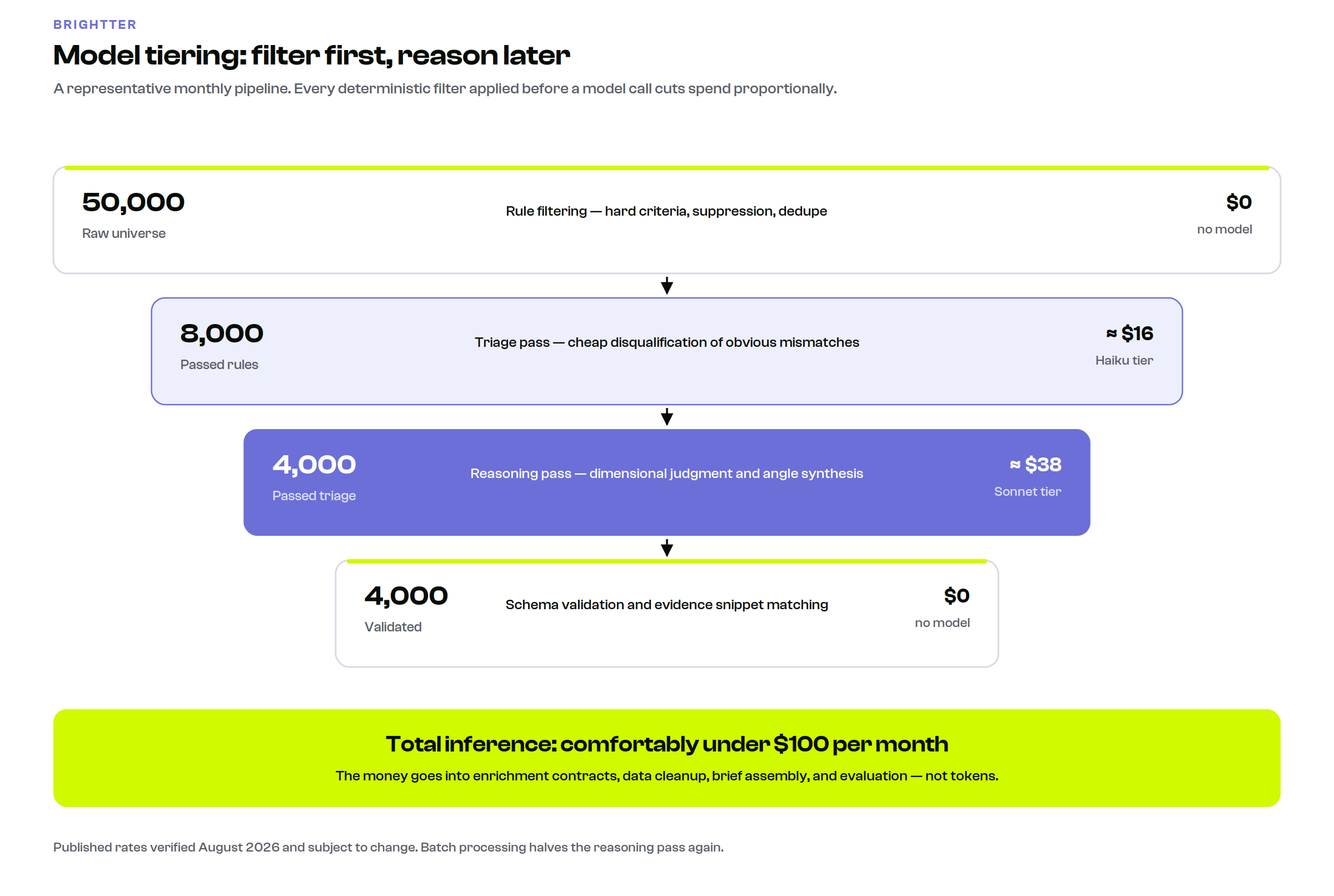
Tier the work. Cheap models for triage and classification, capable models for judgment. A representative monthly pipeline runs in four stages:
- Rule filtering — 50,000 down to 8,000 records, no model. Hard criteria, suppression, deduplication.
- Triage pass — 8,000 down to 4,000 records, Haiku tier. Cheap disqualification of obvious mismatches.
- Reasoning pass — 4,000 records, Sonnet tier. Dimensional judgment and angle synthesis.
- Verification — 4,000 records, no model. Snippet matching and schema validation.
With current published rates — Haiku 4.5 at $1 input and $5 output per million tokens, Sonnet 5 at an introductory $2 and $10 through the end of August 2026 and $3 and $15 thereafter, cache hits billed at roughly a tenth of base input, and a 50% Batch discount — the arithmetic lands in a place most teams find surprising.
A triage call at roughly 1,200 input and 150 output tokens on the Haiku tier costs on the order of $0.002. Eight thousand of them is roughly $16. A reasoning call with a 2,500-token cached prefix, 1,500 tokens of record, and 600 tokens of output on the Sonnet tier costs roughly $0.01 at standard rates. Four thousand of them is roughly $38. Run the reasoning pass through the Batch API and it halves again.
Total inference for a 50,000-account monthly pipeline: comfortably under $100.
That number is the point. The reasoning layer is not where the money goes. The money goes into enrichment vendor contracts, data cleanup, the engineering to assemble clean briefs, and the evaluation discipline to know whether any of it works. Teams that agonize over token costs while running an unevaluated pipeline have optimized the wrong variable by two orders of magnitude. Published rates change; verify current pricing before budgeting.
Failure Handling
Probabilistic components fail differently from deterministic ones, and the pipeline needs to expect it.
- Validate every response against the schema. Reject on any violation. Do not coerce, do not parse leniently, do not accept a nearly-correct object.
- Bounded retries with error feedback. On a validation failure, retry once with the specific validation error appended to the message. Two failures means the record goes to the dead-letter queue.
- Never silently drop. A record that fails twice is a signal about your prompt or your data, and a silently discarded record is a lost diagnostic.
- Idempotency keys. Reruns are normal. Every record needs a stable key so a partial rerun does not double-send.
- Circuit breaker. If the validation failure rate crosses a threshold in a rolling window, halt the run and alert. A sudden spike usually means an upstream data format changed, not that the model degraded.
Evaluation: The Part That Determines Whether Any of This Works
Everything above is architecture. This is the part that tells you whether the architecture is producing value, and it is the step most teams skip entirely.
Build a golden set. Take 200 accounts from your real universe. Have your single best rep — the one whose judgment you would trust over a committee — label each one. Do not label them yourself, and do not use the model to label them. This set takes about a day of one person's time and pays for itself permanently.
Measure precision at the top tier, not accuracy. Outbound universes are heavily imbalanced; a model that tiers everything weak will post excellent accuracy and be useless. The question that matters is: of the accounts the layer called strong, what fraction did your rep also call strong? That is the number that determines whether reps trust the output.
Track abstention rate as a drift canary. A sudden rise means your enrichment quality dropped. A sudden fall usually means a prompt edit made the model less willing to admit uncertainty, which is worse than it sounds.
Run a regression suite on every prompt change. Any edit to the system prompt, however small, re-runs the golden set before deployment. Treat prompt changes exactly like code changes, because that is what they are.
Shadow-run before you trust it. For the first several weeks, generate judgments and show them to reps without acting on them. Measure the rate at which reps agree with the tier and accept the suggested angle. When agreement is consistently high, start routing on it.
Close the loop with reply data. Segment reply rate by tier. If tier A does not measurably outperform tier B, the problem is your rubric, not your model — your dimensions are not capturing what actually predicts a response.
The Brightter Perspective
The pattern we see repeatedly is a team that has built an impressive demo of an AI qualification agent and cannot get it into production, because the demo answered a question that production does not ask. The demo shows that a model can read a company and say something intelligent about it. Production asks whether the model will say something intelligent about ten thousand companies, consistently, without fabricating, at a cost you can defend, in a format your CRM can consume, with evidence a rep can check in five seconds.
The distance between those two things is almost entirely architecture, not model capability. It is the output contract, the boundary between rules and inference, the evidence requirement, the failure handling, and the evaluation set.
At Brightter, we help organizations design that layer deliberately: defining where judgment genuinely belongs to the model and where it belongs in code, specifying strict output contracts that downstream systems can rely on, building the grounding and verification controls that make generated content defensible, and standing up the evaluation discipline that turns a promising pilot into a system a revenue team will actually keep using.
Conclusion
A reasoning layer is not adding AI to outbound. It is a specific engineering decision to place a probabilistic component at exactly one point in a deterministic pipeline, give it a narrow question, constrain its output, verify its claims, and compute everything else in code.
Get the boundary right and the model does the one thing it is genuinely better at than a rule: reading unstructured evidence and forming a bounded judgment about it. Get the boundary wrong and you have paid a premium for inconsistency.
The organizations getting real leverage here are not the ones using the largest model. They are the ones who wrote down their rubric, built a golden set, and can tell you what their top tier's precision is.
If your team is moving AI from experiments into systems that act on real business data, the design of the reasoning layer is where that effort succeeds or stalls. Start a project at brightter.com/start-a-project.