.avif)

Nine Signs Your AI Pilot Is Going to Die in Committee
Key Takeaways
- Most AI pilots do not get rejected. They expire — nobody ever says no, the review cycle simply outlasts everyone's attention
- Attrition is not evenly distributed. More pilots die in the six weeks between working build and approval decision than in scoping and construction combined
- Every stall traces back to one of three classes: sponsorship, scope, or evidence. The class determines the fix, and fixing the wrong one wastes another quarter
- Sponsorship failures look like scheduling problems. When each review adds reviewers instead of resolving questions, no meeting cadence will save it — authority was never actually transferred
- The single most common scope error is choosing the interesting problem rather than the frequent one. Frequency is the numerator of every business case
- Without an evaluation set, quality is argued from anecdote. A committee cannot approve what it cannot measure, so it defers, and deferral is indistinguishable from rejection
- Three or more signs in a single class is structural. Two signs scattered across classes is normal and survivable
- The cheapest intervention is a written kill criterion agreed before the build starts. A project that can fail can also succeed; one that cannot fail can only linger
Introduction: Nobody Ever Says No
The failure mode is remarkably consistent, and it is not the one people expect. The pilot does not blow up. It does not produce embarrassing output or run over budget. It works, more or less, and then it enters review, and then it is spring.
Ask what happened and you will not get a decision. You will get a sequence: the demo went well, then legal had a question, then the sponsor moved to another priority, then someone asked whether a different vendor should be evaluated, then the person who built it took a new role. At no point did anyone decide against it. The project simply ran out of the thing that was actually sustaining it, which was enthusiasm rather than structure.
This matters because the remedies people reach for — more frequent standups, a better demo, a more senior sponsor — treat the symptom. The pilot did not stall because the meetings were badly run. It stalled because it entered the approval stage without the three things an approval stage requires: someone with authority to say yes, a scope narrow enough to evaluate, and evidence that can settle a disagreement.
What follows is a diagnostic. Nine observable signs, grouped by root cause, with the specific intervention each one calls for. It is written to be used on a live project rather than read in the abstract — you should be able to score your own pilot in about ten minutes.
Where Pilots Actually Die
Before the signs, the shape of the problem.
Teams intuitively assume that AI projects fail during the build, on technical grounds. That is where the perceived risk sits, so that is where attention goes. The observed pattern is close to the opposite: technical construction is the most reliable phase, because it has a clear definition of done and a person who owns it. The dangerous stretch is the one after the thing works and before anyone commits to it.
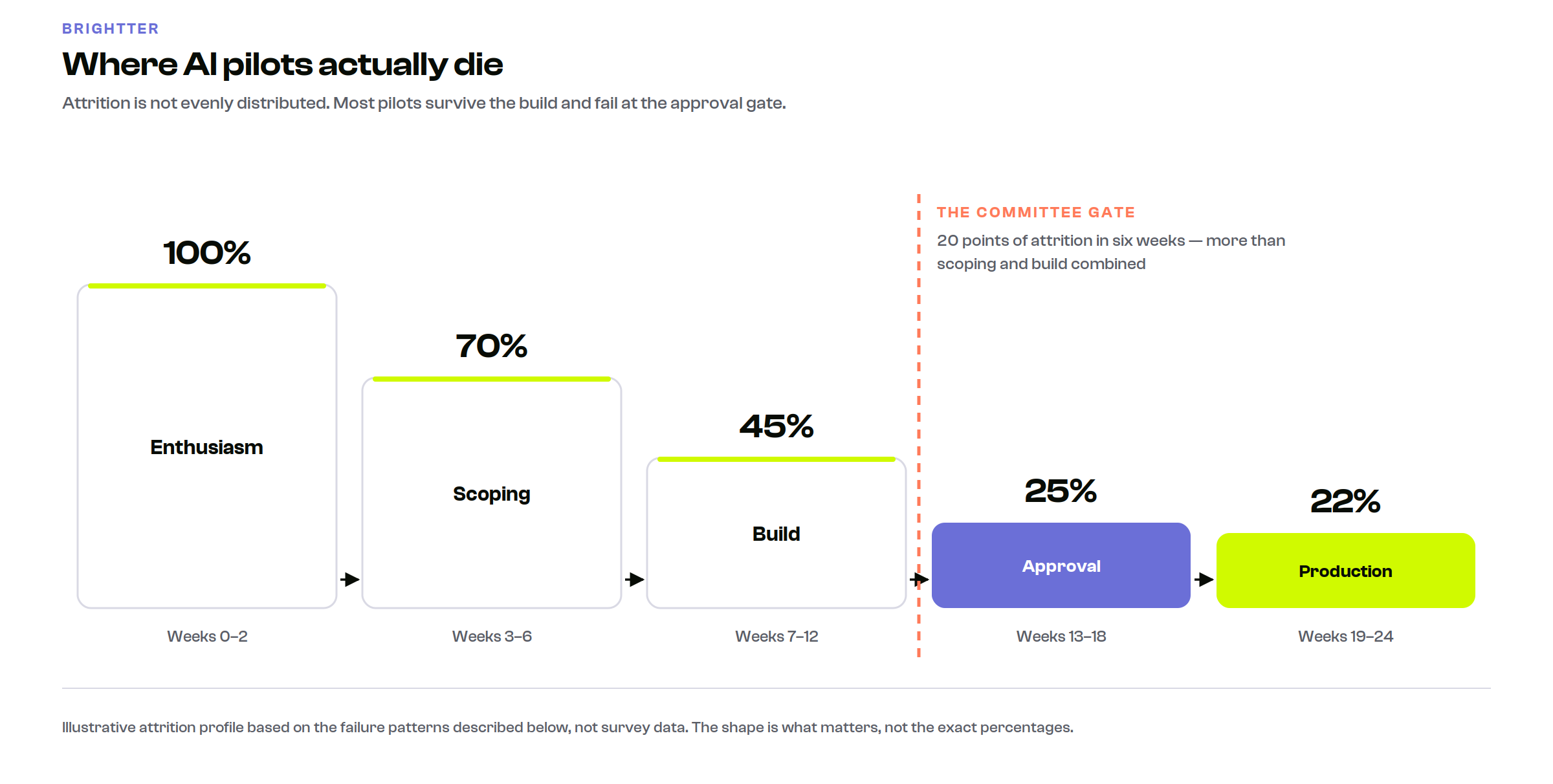
The approval gate is dangerous for a structural reason. Every earlier phase has a single owner who can unblock it. Approval is the first phase with distributed authority and no single owner, which means it is the first phase where the default outcome is inaction rather than progress. A build that stalls gets noticed within a week. An approval that stalls looks exactly like an approval that is proceeding carefully.
Three Failure Classes
Nine signs, but only three underlying causes. Sorting by cause matters because the interventions are completely different, and applying the wrong one is how teams lose a second quarter after losing the first.
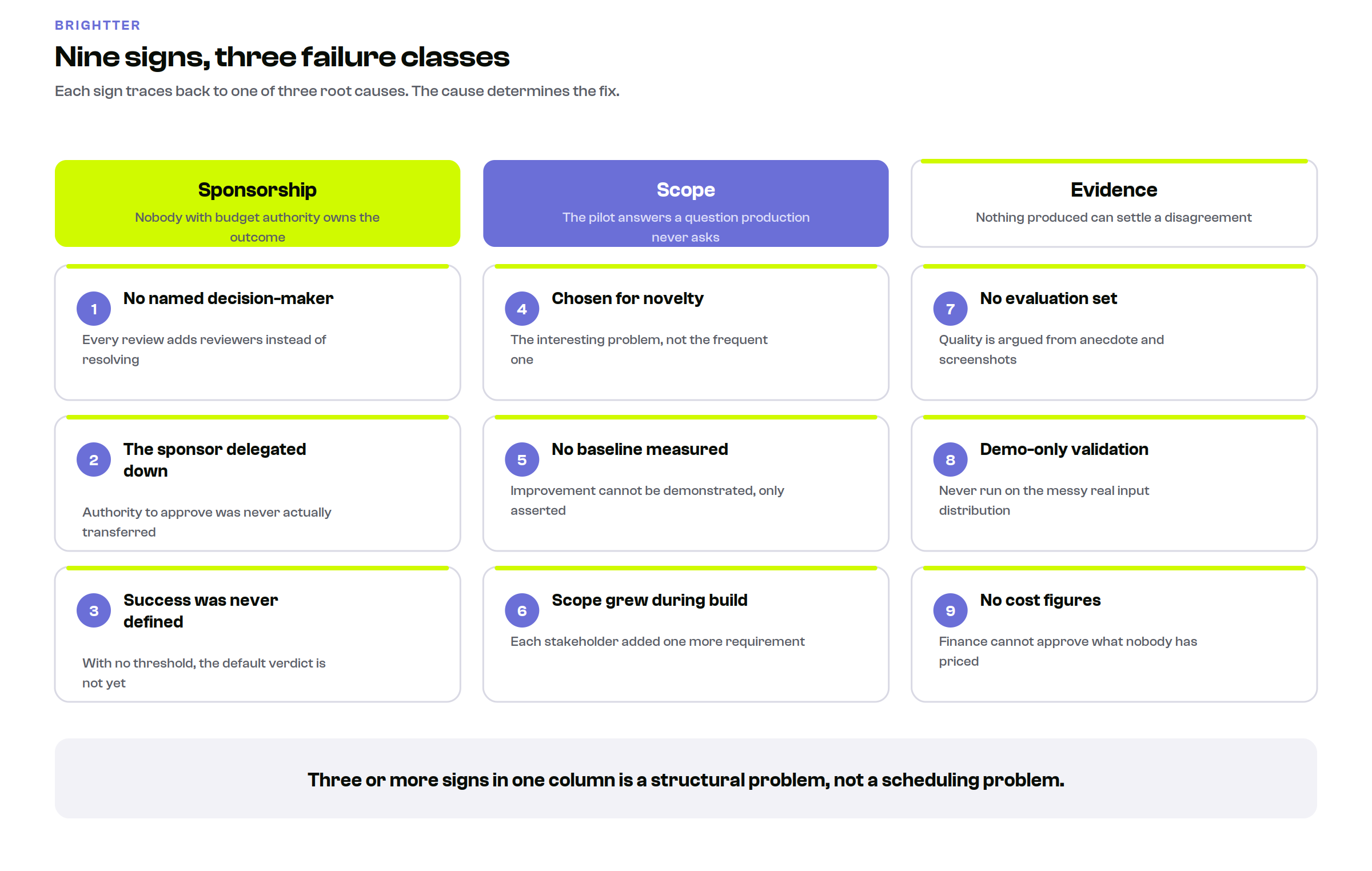
Class One: Sponsorship
Nobody with budget authority owns the outcome. These are the hardest to see from inside, because the project usually has a sponsor on paper.
Sign 1: There is no named decision-maker. Ask who decides whether this goes to production. If the answer is a committee, a forum, or a name followed by “and a few others,” you have found the problem. The diagnostic tell is that each review meeting adds attendees rather than resolving questions — a healthy review narrows, a stalled one broadens.
The fix: name one person, in writing, and get them to confirm it. Not the most senior available person — the most senior person who will actually attend. A director who shows up beats a VP who forwards the deck.
Sign 2: The sponsor delegated down without transferring authority. An executive endorsed the project and handed it to a manager. The manager can run it but cannot approve it, and the executive has stopped attending. Everyone believes someone else is empowered.
The fix: make the delegation explicit and bounded. “This person can approve production deployment up to a spend of X” is a sentence that unblocks months of drift.
Sign 3: Success was never defined. There is no number, no threshold, no date. In the absence of a defined bar, every review defaults to “not yet” — because “not yet” is always defensible and “yes” never is.
The fix: write one sentence before the next review. If the system does X on Y by Z, we deploy. Get the decision-maker to agree to the sentence rather than to the project.
Class Two: Scope
The pilot answers a question production never asks. These failures are set in motion before any code exists.
Sign 4: The workflow was chosen for novelty. Someone picked the most technically interesting problem in the organization. Interesting problems are usually infrequent, ambiguous, and high-stakes — the three properties that make automation hardest to justify and hardest to approve.
The fix: re-select against frequency. The task worth automating is boring, high-volume, and well-defined. If your pilot subject happens twice a month, no result will justify a build.
Sign 5: No baseline was measured. Nobody recorded how long the task took or how often it was wrong before the pilot started. Improvement can now only be asserted, never demonstrated, and assertion does not survive a finance review.
The fix: measure the baseline retroactively if you must. A week of timing the manual process is worth more in the approval meeting than another month of refinement.
Sign 6: Scope grew during the build. Each stakeholder added one requirement, none individually unreasonable. The pilot now spans three departments and cannot be evaluated as a unit, because no single reviewer understands all of it.
The fix: cut back to the original workflow and ship that. Additions become a documented phase two. A narrow thing that works is approvable; a broad thing that mostly works is not.
Class Three: Evidence
Nothing the project produced can settle a disagreement. This is the class that produces the longest, most exhausting review cycles.
Sign 7: There is no evaluation set. Quality is discussed using screenshots and anecdotes. One reviewer recalls a bad output; another recalls a good one. Neither can be checked, so the conversation cannot converge, so it repeats.
The fix: build a golden set of thirty to a hundred real examples labeled by your best domain person, and report a single number against it. This takes about a day and changes the character of every subsequent meeting, because disagreement becomes measurable rather than rhetorical.
Sign 8: Validation was demo-only. The system was tested on clean, representative inputs. It has never seen the malformed PDF, the multi-currency invoice, or the request that contains no answer at all. Reviewers sense this even when they cannot articulate it, and their hesitation is correct.
The fix: run it in shadow mode against real production input for two weeks and publish the failure rate honestly. A known 12% failure rate with a defined review gate is far more approvable than an unmeasured system that demos beautifully.
Sign 9: There are no cost figures. Nobody has priced inference, ongoing operations, or the internal hours the workflow will consume. Finance cannot approve an unpriced commitment, so it defers.
The fix: produce a one-page annual figure covering inference, operations, and loaded internal time. The number is usually far smaller than the room expects, which is itself a useful thing to discover in advance.
Scoring Your Own Pilot
Count the signs, then look at their distribution rather than the total.
Two or fewer, scattered across classes. Normal. Every project has some of this. Address them opportunistically.
Three or more within a single class. Structural. The project will not be rescued by working harder on the build, because the build is not the constraint. Stop feature work and fix the class.
At least one from every class. The pilot was set up to stall before it began. This is the case where restarting with a different, more boring workflow is genuinely faster than repairing the current one — a conclusion nobody wants and that is usually correct.
The Forty-Eight Hour Triage
If you scored badly, the sequence below is deliberately ordered. Each step is cheap, and each unblocks the next.
Hour one: name the decision-maker. One person, confirmed in writing, who can say yes. Nothing else matters until this exists, because every other artifact you produce needs a recipient with authority to act on it.
Day one: write the success sentence. One measurable threshold and a date. Get agreement on the sentence, not the project.
Day one: write the kill criterion. If the threshold is not met by the date, the project stops. This is the step teams resist and the one that most reliably produces a decision, because it converts an open-ended commitment into a bounded one.
Day two: start the golden set. Thirty examples is enough to change the next conversation. Have the domain expert label them, not the builder.
Day two: produce the cost page. Annual inference, annual operations, loaded internal hours. One page.
None of this is technical work, which is exactly why it gets deprioritized in favor of technical work that feels more productive and is not.
What a Surviving Pilot Looks Like
For contrast, the profile of the projects that make it through is unremarkable and consistent. One named owner with authority. One boring, frequent workflow. A measured baseline from before the build. A golden set with a number attached. Two weeks of shadow-mode results including the failure rate. A one-page cost figure. A written threshold and a written kill date.
Notice that none of those are properties of the model, the vendor, or the sophistication of the implementation. A team with all seven and a mediocre technical build will ship. A team with none of them and an excellent build will not.
The Brightter Perspective
The most expensive thing about a stalled pilot is not the money spent on it. It is what it teaches the organization. A project that lingers for two quarters without a decision produces a durable internal belief that AI is overhyped and does not work here — a belief formed with no evidence about the technology at all, since the pilot was never actually evaluated.
That belief is difficult to reverse and it suppresses the next three proposals. Which means the real cost of a stalled pilot is the two years of capability the organization does not build afterward.
At Brightter, we spend a disproportionate share of early engagement time on the parts of this that are not technical: identifying which workflow is boring enough to be worth automating, establishing the baseline before anything is built, constructing the evaluation set that makes quality arguable in numbers, and writing the success and kill criteria while everyone is still optimistic. The build is the part that reliably works. Everything around it is where projects are won or lost.
Conclusion
A pilot that dies in committee was almost never killed. It expired, in a phase with distributed authority and no owner, because it arrived there without a decision-maker, a narrow scope, or evidence a reviewer could act on.
Score yours honestly. Look at the distribution rather than the count. If three signs cluster in one class, stop building and fix that class, because more build will not help. And write the kill criterion before you need it — a project that is allowed to fail is a project that is allowed to succeed.
If you have a pilot that works and has not been approved, the constraint is almost certainly one of the three classes above. Start a project at brightter.com/start-a-project.